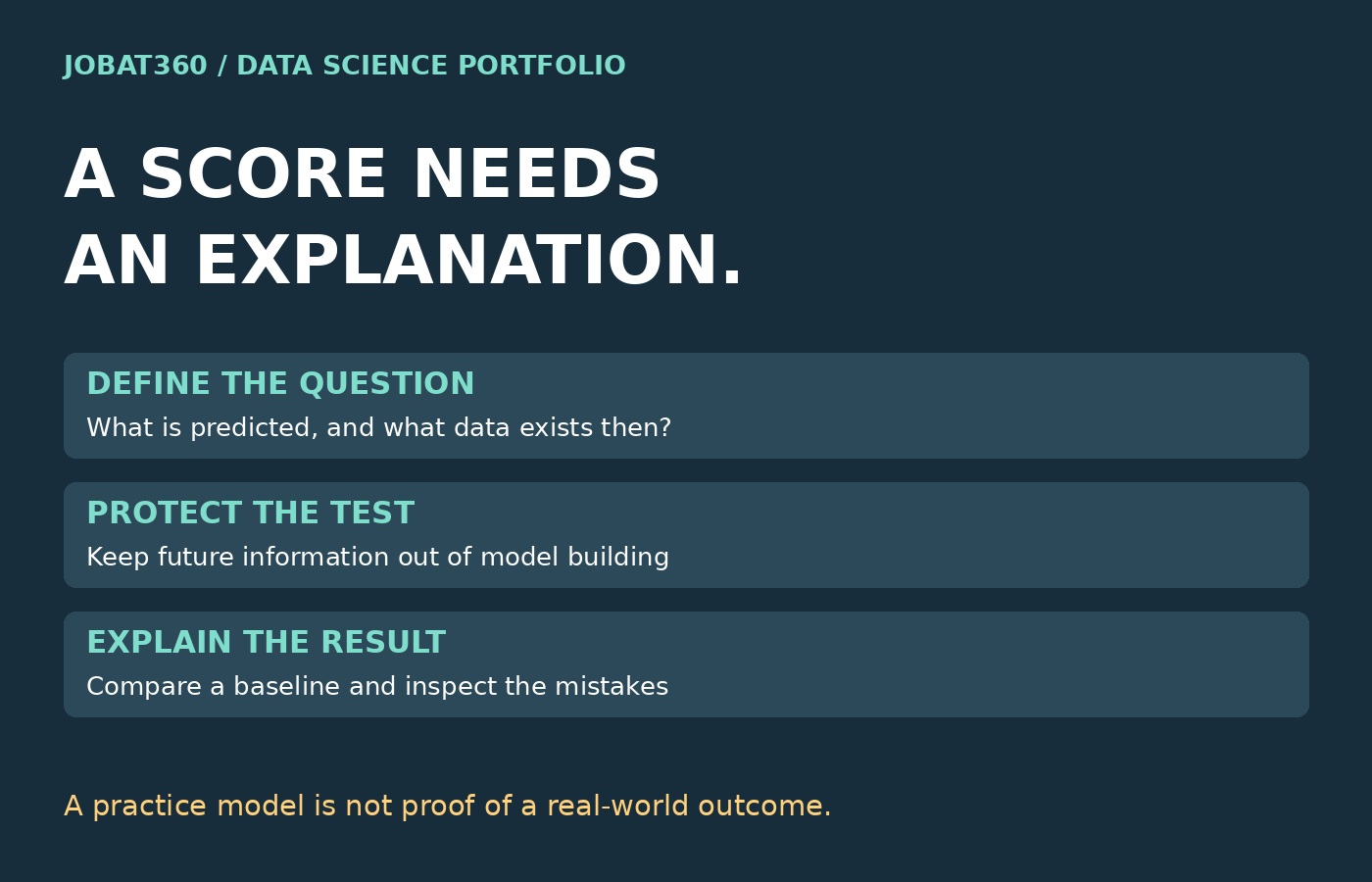
A high model score is not a complete data-science portfolio. The useful question is whether someone else can understand the problem, inspect the data choices and see why the result deserves trust. Start there, before adding another algorithm to a notebook.
This guide explains how to choose a starting kind of data work and build a small, credible project. It does not list current vacancies, salaries, course fees or placement promises. Each employer’s actual requirements still decide eligibility.
Read the work, not only the title
For your search, separate three questions: do you want to explain existing data, build predictions, or make a data system reliable? These are useful ways to read responsibilities, not fixed definitions that every employer follows.
A reporting task might ask you to define a metric, check a query and explain a trend. A modelling task might ask you to choose a target, compare approaches and evaluate errors. A production task might ask how data arrives, how a model is served and what happens when inputs change. One vacancy may combine them; another may divide them across a team.
Microsoft Learn’s model-building path includes data exploration, regression, classification and clustering. Google’s production-ML guidance adds schema checks, feature checks, monitoring and real-world performance. Together they show why a finished chart and a running prediction service are different deliverables.
Choose one question that you can finish
Do not begin with a promise to transform an industry. Write a question with a defined unit, period and output. For example: which categories in a public practice dataset have the most missing values? Or, for a prediction exercise, which information would genuinely exist before the outcome you are trying to predict?
Then record the source, download date, licence or permitted use, column meanings and known limitations. Say whether the data is public, synthetic or supplied with permission. Public accessibility is not a substitute for checking reuse terms, and a portfolio should not expose personal or confidential records.
A useful first deliverable is a data note. List duplicate rows, missing fields, inconsistent units and exclusions. Explain what you changed and retain enough information to reproduce the cleaning. Do not silently discard inconvenient observations because they make a result look worse.
Keep the question separate from the answer
If your project predicts an outcome, identify the target and list what would be available at prediction time. A feature is an input to the model; the target is what you want it to predict. Information recorded after the outcome may make an exercise look impressive while making it unusable for the intended decision.
For a fictional delivery exercise, suppose the aim is to predict a late arrival when an order is placed. The actual arrival timestamp is not available then. Including it, or a field calculated from it, would reveal information from the future. This is an explanatory example, not a real delivery model.
Scikit-learn describes data leakage as using information during model building that would not be available at prediction time. Its examples also show how preprocessing can leak information even when the final estimator never directly sees the test labels.
Split before learning from the data
Google’s Machine Learning Crash Course distinguishes training, validation and test sets. Training data is used to fit the model; validation supports development choices; the test set is a separate final check. Repeatedly using the same test results to choose features or settings weakens that separation.
There is no universal split percentage to copy into every project. Explain why your evaluation represents the future examples you care about. Check for duplicate examples crossing the split. Where the task depends on time or repeated entities, investigate an appropriate evaluation design rather than assuming an ordinary random split settles the question.
Scikit-learn’s guidance is particularly clear about learned preprocessing: fit transformations using the training portion, then apply those learned transformations to other portions. A pipeline helps keep preprocessing and the estimator together during evaluation. It is a useful tool, not a guarantee that the target, dataset or evaluation design is sensible.
Compare with something simple
A complex method needs a reference point. Scikit-learn’s DummyClassifier provides simple predictions that ignore input features so they can be used as a baseline. You should explain the baseline and evaluate the comparison on the same held-out examples and the same chosen measure.
Consider a fictional set of 100 cases, 95 of which belong to one class. A rule that always predicts that class is correct on 95 cases, giving 95% accuracy, while missing every one of the five minority cases. These numbers are invented for explanation. They show why a percentage without the class counts and error types can hide the very problem you wanted to solve.
Decide which mistakes matter for the task, then report them. Do not call a model useful merely because its accuracy looks high. A project can be valuable even when a simple baseline wins, provided you explain what you learned and what evidence would justify trying again.
Make the portfolio inspectable
Use a short project note alongside the notebook or code. A reader should not have to run every cell to discover your question or your limitations.
- Purpose: the question, intended user and output.
- Data: source, permission, unit of observation and exclusions.
- Method: cleaning, baseline and any modelling choices.
- Evaluation: split design, measure, error analysis and comparison.
- Reproduction: steps, dependencies and versions needed to rerun the work.
- Limits: what the result does not establish and what you would check next.
Explain your own contribution. If you adapted a tutorial, link it and say what you changed. If a tool helped generate code, inspect and test the code before presenting it. Do not claim a practice notebook is deployed software or claim a team result as solely your work.
Keep private keys, access tokens, customer exports and internal documents out of the repository. An interviewer needs evidence of your method, not access to an organisation’s accounts. Use a permitted public dataset or a clearly labelled synthetic example when you cannot share the original.
A notebook result is not a production result
Google’s production-ML documentation recommends validating raw data against a schema, checking engineered features and examining important data slices. It also distinguishes a model’s metric from the real-world impact of using it. A good overall score can conceal poor performance in a relevant subset.
For a learning project, add a short handover note: what inputs are expected, what should be rejected, what could change and how failure would be noticed. You do not have to build a production system to show that you understand these questions. Just avoid pretending that an untested deployment is complete.
Similarly, do not turn a classroom predictor into advice about medical care, credit, hiring or investments. A training exercise does not establish that a system is safe or suitable for consequential decisions.
Choose learning around the missing step
If you cannot explain the data, work on exploration and basic statistics before adding model complexity. If the question is clear but your code is hard to rerun, work on organisation and testing. If your score is strong but suspicious, investigate leakage, duplicates and the baseline.
Microsoft’s cited path assumes basic mathematical knowledge and says Python experience is beneficial. Scikit-learn’s Getting Started guide itself assumes basic familiarity with machine-learning practices. Those are learning prerequisites, not a universal hiring rule and not a promise that completing a path qualifies you for every data-scientist vacancy.
Before paying for a course, inspect its current syllabus, prerequisites, assessment, total price and refund terms. Check what any placement-support claim actually provides. This guide does not endorse a paid programme or reproduce the source article’s course-fee table.
Read each vacancy against your evidence
Record the actual duties, mandatory qualifications, experience, location and application route. Then connect a sample to one responsibility: a checked analysis for reporting, an honest evaluation for modelling, or tests and monitoring notes for system work. Do not replace a missing mandatory qualification with confidence in a portfolio.
When discussing a project, be ready to explain an error, an alternative you rejected and what you would not infer from the result. Those answers make a small project more credible than an unexplained leaderboard number.
Questions beginners often ask
Must every portfolio contain deep learning?
No. Select methods that fit your question and the work you are applying for. A clear analysis or a simple model with sound evaluation is a better learning result than unnecessary complexity you cannot explain.
Can a tutorial become a portfolio project?
Yes, if you identify the tutorial, state your own changes and explain the work. Copying its output and presenting it as an independent result is a different claim.
Does a good test score prove the model will work in practice?
No. The test data may not represent the intended use, information may have leaked, or conditions may change. Report the evaluation design and limits, then distinguish the offline result from a real-world outcome.
Will AI remove the need to learn the basics?
This guide makes no employment forecast. Whatever tools you use, the data source, target, evaluation and claimed result still need checking. Generated code does not remove responsibility for those choices.
Start with one defensible project. Ask a narrow question, keep the data honest, compare with a baseline and explain where your conclusion stops.
Sources and scope
Checked 28 November 2026. The workflow and fictional examples are original editorial guidance. Technical documentation supports the evaluation principles below; it does not verify any current opening or salary.
- Chegg India: Data Science Jobs, complete source article and FAQs read for topic coverage. Salary tables, course fees, current-hiring claims and AI employment forecasts are not repeated.
- Scikit-learn: common pitfalls, leakage, preprocessing and evaluation separation.
- Google Machine Learning Crash Course: dividing datasets, training, validation, test data and duplicate risks.
- Scikit-learn: Getting Started, fitting, pipelines and evaluation.
- Scikit-learn: DummyClassifier, simple baseline strategies.
- Microsoft Learn: Create machine learning models, learning coverage and prerequisites.
- Google: monitoring production ML pipelines, data validation, slices, skew and real-world metrics.
Jobat360 is an independent information publisher, not an employer, recruitment agency or application portal. No course result, vacancy, interview, job or salary is guaranteed.
Disclosure: For information and education only, not investment advice. We are not a SEBI-registered analyst. Double-check original sources before financial decisions. We hold zero shares in companies mentioned in this article. We do not take or promote positions on misleading price information for personal gain, or use this platform to mislead traders or investors. Our purpose is financial literacy and access to information, without a personal or monetary motive behind the information shared.
FOLLOW WOLF OF INDIA, FREE EVERYWHERE
WEBSITES
Wolf of Dalal Street: https://wolfofdalalstreet.com
Stockmarket360: https://stockmarket360.in
BizTechIndia: https://biztechindia.com
Jobat360: https://jobat360.com
Trending on Net: https://trendingonnet.com
Blog + daily digest: https://wolfofdalalstreetofficial.blogspot.com and https://wolfofindia.blogspot.com
APP
Free news app: https://wolfnews.surge.sh (turn on notifications)
YOUTUBE
Wolf of Dalal Street: https://www.youtube.com/@WOLFOFINDIA360
CHANNELS (free updates by message, our newsletter)
WhatsApp channel: https://whatsapp.com/channel/0029VaswZ107YSdBnLu1FY3g
Telegram (Wolf of India): https://t.me/WOLFOFINDIA
Telegram (Wolf of Dalal Street): https://t.me/wolfofdalalstreetofficial
Telegram (Stockmarket360): https://t.me/stockmarket360official
Telegram (BizTechIndia): https://t.me/biztechindia
Telegram (Trending Online): https://t.me/Trendingonlineofficial
WhatsApp Business (join, message preferred): https://wa.me/919619991645
PROFILES
LinkedIn: https://www.linkedin.com/company/wolfofdalalstreet/
Instagram: https://www.instagram.com/wolfofindiaofficial
Facebook: https://facebook.com/wolfofdalalstreetofficial
X: https://x.com/Wolf_India360
Reddit community: https://www.reddit.com/r/WOLFOFDALALSTREETJOIN/
Quora Space: https://wolfofdalalstreet.quora.com
Diigo: https://www.diigo.com/user/wolfdalalstreet
RSS FEEDS
https://wolfofdalalstreet.com/feed/ | https://stockmarket360.in/feed/ | https://biztechindia.com/feed/ | https://jobat360.com/feed/ | https://trendingonnet.com/feed/ | https://wolfofdalalstreetofficial.blogspot.com/feeds/posts/default
Market and business education only. Not investment advice. No tips, no targets.