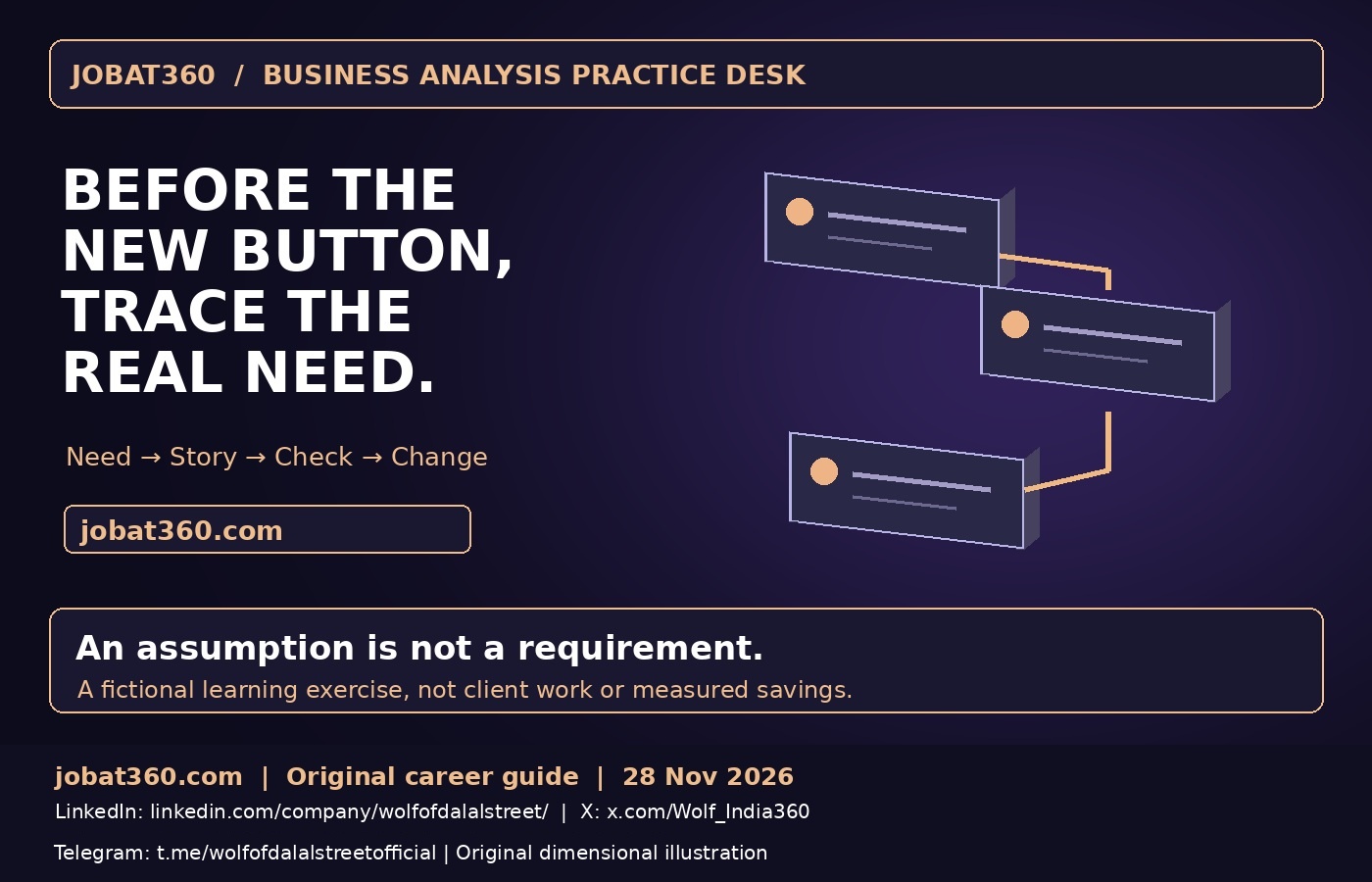
Business analysis practice desk | 28 November 2026
A stakeholder asks for a new button. Before documenting the button, find out what the person needs to achieve, what is failing today and how anyone will know that the change worked. That chain is a useful place to begin learning business analysis.
This original Jobat360 guide uses Chegg India’s career article as the topic source, checked against IIBA and the GOV.UK Service Manual. Its focus is a small, reviewable requirements exercise. It is not a current vacancy list, salary comparison or promise that a certificate will secure employment.
Learn to connect the need to the proposed change
IIBA’s Business Analysis Standard describes business analysis through needs, change, solutions, stakeholders, value and context. A solution may include a manual procedure or process change, not only software. Start by understanding why something should change before selecting a tool.
For career preparation, this means showing your reasoning. Can you distinguish a request from an evidenced need? Can you explain who benefits, who has to do extra work and which constraints matter? A diagram is useful when it helps answer those questions, not because it looks like a professional deliverable.
Job titles vary. Read the specific vacancy’s duties, qualification, domain, location and experience requirements. This guide establishes no universal degree, MBA, language or software requirement for every business analyst.
Practice proposal: a fictional equipment-loan service
Imagine a small organisation lends presentation equipment to staff. Someone asks for a new booking app because people cannot tell whether an item is available. This is an original fictional exercise, not a client project, observed user problem or implemented result.
Begin with questions rather than declaring the app to be the answer. How are requests handled now? When does an item count as available? Who checks a return? What happens when a reservation changes or the item needs repair? Which information may each person see?
Keep an assumption log. In a real authorised project, investigate with appropriate evidence and people. In a solo exercise, label the answers you invent. Do not present fictional interviews as user research.
Write the need without smuggling in the solution
The GOV.UK Service Manual advises grounding user needs in research and focusing on the problem rather than the chosen feature. It also treats opinions that do not come from users as assumptions requiring investigation. This is UK government service-design guidance used here as a learning example, not a rule binding every Indian employer.
In the fictional exercise, “we need an app” is a proposed solution. A candidate need might be knowing whether suitable equipment can be borrowed for a particular period. That candidate still needs validation. A different process, clearer responsibility or an improved existing tool could be worth comparing.
Separate the borrower from the person maintaining the equipment and the person administering loans. Their needs may conflict. Making booking easier is not enough if broken equipment is incorrectly shown as ready to use.
Build a small traceability chain
The GOV.UK guidance connects user needs to user stories and acceptance criteria. It explains that stories identify the person, the intended action and its purpose; acceptance criteria describe outcomes used to check whether the work meets the need.
For this exercise, make a compact record with these fields:
- Need: the outcome the person wants, with its evidence or assumption label.
- Story: one bounded action serving that need.
- Acceptance check: an observable outcome, including a relevant exception.
- Open question: a policy or decision that has not been settled.
- Owner and status: who may decide and whether the item is proposed, agreed or tested.
A fictional story could concern checking availability for a chosen loan period. Proposed checks might ask whether conflicting confirmed loans and items marked unavailable are handled according to an agreed rule. The rule is deliberately not invented here. Deciding how reservations, repairs and overrides work belongs to the organisation responsible for the service.
Assign simple identifiers so a reviewer can follow a need through its story and checks. Do not turn a sentence into a requirement merely because it has an ID. An unvalidated assumption remains an assumption in a well-formatted table.
Test the exception, not only the happy path
What if two requests overlap? What if a return is late? What if a member of staff cannot use the normal booking channel? What if equipment is returned but not yet checked? These questions can expose missing decisions before anyone builds the interface.
You do not need to invent a production system to demonstrate this work. A short process sketch and a decision log can show where the handover is unclear. Record what needs an answer instead of silently choosing a convenient policy.
Acceptance checks are not evidence that a service has passed them. Keep proposed, reviewed and actually tested items separate. In a portfolio, say who reviewed the exercise and what feedback you received only when that happened.
Handle a change without losing the reason
Suppose the fictional organisation later asks for manager approval on some loans. Trace which people, stories, checks and responsibilities could be affected. Ask why approval is needed and which situations it covers. Do not simply add an approval screen and declare the analysis complete.
IIBA’s Standard includes work on tracing requirements, assessing changes, verifying requirements and validating them. For a beginner’s exercise, the practical lesson is to retain the links between the need, the proposed solution and the evidence used to judge it. The exact method should fit the project.
Keep an earlier version and explain the reason for a revision. A reviewer should be able to distinguish a genuine new decision from a mistake corrected in the document.
Choose learning against a gap, not a software collection
If you cannot describe the current process, practise observation and process modelling. If your checks are vague, practise writing outcomes someone can assess. If the question depends on data, learn the analysis tools needed to inspect it. If stakeholders disagree, practise recording the disagreement and the decision needed.
SQL, spreadsheets, modelling tools and programming can matter in particular roles. Their presence on a career page does not make every item mandatory for every vacancy. Show what a tool helped you establish rather than listing it without work you can explain.
A useful portfolio packet for the fictional loan service could include the brief, assumption log, process sketch, traceability record, change example and limitations. Label it as practice. Do not use private workplace records or imply a real commercial result.
Keep beginner credentials separate from experienced ones
IIBA’s current ECBA page says no prior business-analysis experience is required. Its certification FAQ adds agreement to its conduct standards and certification terms. That is an exam-entry statement, not a guarantee that a particular employer will hire someone without experience.
The same FAQ describes experience and other requirements for CCBA and CBAP. Those credentials should not be recommended as interchangeable beginner steps simply because all appear in a career article. Check the issuer’s current handbook and your own eligibility before paying.
This guide does not compare prices or enrol you in training. A course completion, a certification, practical evidence and an employment offer are different outcomes.
Questions beginners ask
Can I start after BBA or engineering?
Use the actual employer or programme requirements. Your earlier study may supply relevant evidence, but it does not establish eligibility for every role. Compare what you have done with the work requested.
Do I need Python?
No universal answer is established here. A role involving substantial data work may ask for it; another may emphasise other methods. Read the vacancy and choose learning around the tasks.
Can I become a business analyst with no experience?
You can begin learning and producing honest practice work. Whether a role accepts that background is the employer’s decision. A fictional project must not be represented as paid experience.
What salary should I expect?
Chegg supplies aggregate salary and growth figures that were not independently remeasured here. This guide offers no current pay band or demand forecast. Compare the actual role, level, location and offer terms.
Sources and limits
Read on 28 November 2026. Full Chegg article and FAQ reviewed. Independent educational guidance; no user interviews, implementation, measured savings or hiring outcome claimed. The practice exercise is distinct from our earlier business-analyst-versus-data-analyst comparison: this guide follows requirements, exceptions and changes through a single learning exercise.
- Chegg India career guide, topic and FAQ source.
- IIBA Business Analysis Standard, 2025 edition, core concepts and requirements tasks.
- GOV.UK user-needs guidance, updated 23 March 2017; evidence, assumptions and traceability.
- GOV.UK user-stories guidance, updated 23 May 2016; actor, goal and acceptance criteria.
- IIBA ECBA page, current beginner credential scope.
- IIBA certification FAQ, credential-specific eligibility and terms.
Disclosure: For information and education only, not investment advice. We are not a SEBI-registered analyst. Double-check original sources before financial decisions. We hold zero shares in companies mentioned in this article. We do not take or promote positions on misleading price information for personal gain, or use this platform to mislead traders or investors. Our purpose is financial literacy and access to information, without a personal or monetary motive behind the information shared.
FOLLOW WOLF OF INDIA, FREE EVERYWHERE
WEBSITES
Wolf of Dalal Street: https://wolfofdalalstreet.com
Stockmarket360: https://stockmarket360.in
BizTechIndia: https://biztechindia.com
Jobat360: https://jobat360.com
Trending on Net: https://trendingonnet.com
Blog + daily digest: https://wolfofdalalstreetofficial.blogspot.com and https://wolfofindia.blogspot.com
APP
Free news app: https://wolfnews.surge.sh (turn on notifications)
YOUTUBE
Wolf of Dalal Street: https://www.youtube.com/@WOLFOFINDIA360
CHANNELS (free updates by message, our newsletter)
WhatsApp channel: https://whatsapp.com/channel/0029VaswZ107YSdBnLu1FY3g
Telegram (Wolf of India): https://t.me/WOLFOFINDIA
Telegram (Wolf of Dalal Street): https://t.me/wolfofdalalstreetofficial
Telegram (Stockmarket360): https://t.me/stockmarket360official
Telegram (BizTechIndia): https://t.me/biztechindia
Telegram (Trending Online): https://t.me/Trendingonlineofficial
WhatsApp Business (join, message preferred): https://wa.me/919619991645
PROFILES
LinkedIn: https://www.linkedin.com/company/wolfofdalalstreet/
Instagram: https://www.instagram.com/wolfofindiaofficial
Facebook: https://facebook.com/wolfofdalalstreetofficial
X: https://x.com/Wolf_India360
Reddit community: https://www.reddit.com/r/WOLFOFDALALSTREETJOIN/
Quora Space: https://wolfofdalalstreet.quora.com
Diigo: https://www.diigo.com/user/wolfdalalstreet
RSS FEEDS
https://wolfofdalalstreet.com/feed/ | https://stockmarket360.in/feed/ | https://biztechindia.com/feed/ | https://jobat360.com/feed/ | https://trendingonnet.com/feed/ | https://wolfofdalalstreetofficial.blogspot.com/feeds/posts/default
Market and business education only. Not investment advice. No tips, no targets.