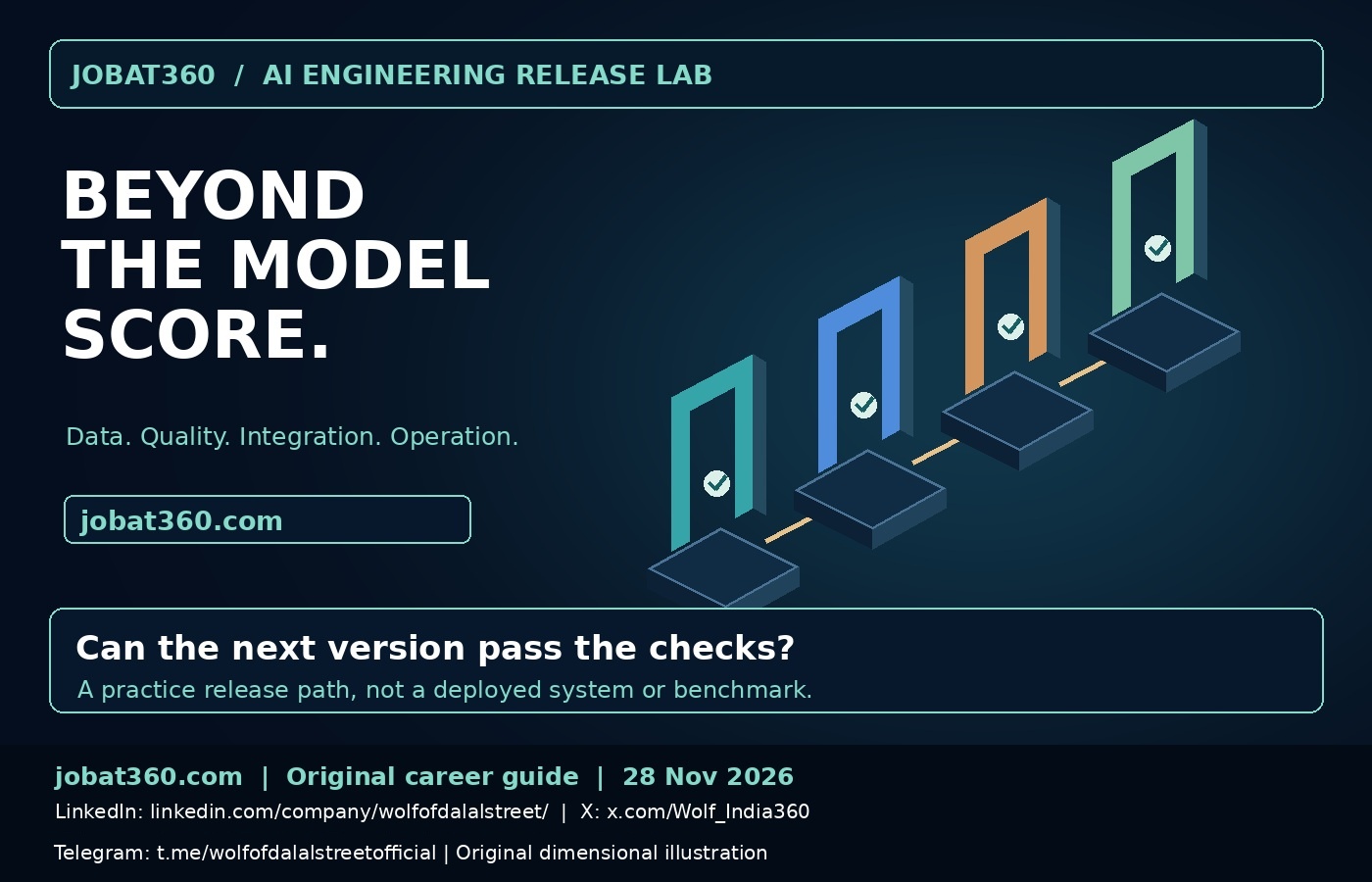
AI engineering release lab | 28 November 2026
Your model runs in a notebook. Then an input arrives with a missing field, the server has a different dependency version and nobody knows which model produced yesterday’s answer. That is where an AI-engineering learning plan needs to go beyond choosing an algorithm.
This original Jobat360 guide uses Chegg India’s article on becoming an AI engineer as the topic source, checked against Google and scikit-learn documentation. Its focus is the handover from an experiment to a small, testable service. It is not a current vacancy list, salary survey, degree-eligibility ruling or promise that a short course makes someone job-ready.
Start by asking what the engineer must own
A job title alone does not specify whether you will train models, prepare data, integrate an existing model, maintain serving infrastructure or support a combination of these tasks. Read the actual vacancy and ask who owns data quality, evaluation, deployment, monitoring and incident response.
Google’s production-ML module describes a system with data collection, verification, feature extraction, configuration, resource management, monitoring and serving infrastructure alongside model code. It is a useful warning against treating the trained model as the whole deliverable.
For a first project, make the boundary deliberately small. State the input, output, intended use and things the system must not be used for. A demonstration of ordinary software behaviour around a model can show engineering work that a screenshot of a prediction cannot.
Learn foundations against tasks you need to perform
Google’s Machine Learning Crash Course recommends comfort with variables, equations, graphs, histograms and statistical means, as well as programming ability. Its exercises use Python, with prework for NumPy and pandas. It also says its emphasis is ML concepts rather than teaching particular APIs in depth.
That is a course prerequisite description, not a universal employer rule. Use it to identify gaps. Can you read a function, inspect a data structure, explain a mean and distinguish a training result from an evaluation result? If not, build those skills before stacking tools into a project you cannot explain.
Chegg names several languages, frameworks and educational routes. Do not turn that into a requirement to master every item before starting. Nor should a learning-resource admission policy be confused with a company’s degree or experience requirement. The employer’s current notice decides that application.
Project proposal: a fictional maintenance-ticket router
The following is an original practice proposal, not a deployed system or a measured result. Imagine routing fictional equipment-maintenance tickets into a small set of categories for a person to review. Do not use real employee messages, account details or private support records.
Write a short service contract before building it:
- Input: the permitted fields, their types, required values and maximum size.
- Output: the category, the model version and whether the request could be processed.
- Boundary: this is routing assistance, not equipment-safety advice or permission to operate machinery.
- Failure behaviour: malformed or unsupported inputs should receive an explicit outcome rather than an invented successful answer.
- Review: identify where a person must check the suggestion before it affects real work.
If all examples are synthetic, say so prominently. A synthetic demonstration can test code paths. It does not establish performance on real users, actual maintenance language or operational incidents.
Gate one: the same input must mean the same thing
Google’s deployment-testing guidance includes checks for input data and feature engineering. Scikit-learn explains why preprocessing must be consistent between training and later data: a changed feature representation can undermine model performance.
For the proposed router, inspect what happens to empty text, unknown categories in auxiliary fields, unexpected field types and an input that exceeds the documented limit. Check that feature order and transformations match the model’s expectations. An HTTP response saying that the request arrived is not evidence that the prediction was valid.
Learned transformations need the same care as the estimator. Scikit-learn advises learning preprocessing from training data, then applying the learned transformation to other data. A pipeline helps keep the transformation and estimator together. It does not decide whether the data, target or intended use is sensible.
Record the data and preprocessing version used for each model release. If an input contract changes, decide which clients and tests must change with it. Do not silently interpret a new field layout using an older model’s assumptions.
Gate two: a new version must pass a defined quality check
A service that starts successfully can still produce worse predictions. Google’s guidance separates sudden degradation from slow degradation across versions. It recommends comparison with the previous version and a fixed quality threshold, rather than assuming each small change is harmless.
Choose the evaluation measure and acceptance conditions before inspecting the final result. Keep development choices separate from the final test. Scikit-learn warns that repeatedly adjusting settings against a test set leaks knowledge of that set into the process, weakening the claim about unseen data.
In the fictional router, report the kinds of category errors, not only one overall percentage. Define what you would do when the agreed checks fail. A result below the acceptance condition should stop that proposed release, not trigger quiet editing of the condition until it passes.
There is no universal pass mark provided here. A threshold suitable for a classroom demonstration does not authorise a safety-critical system. No model was trained or evaluated for this article.
Gate three: the parts must work together
Google calls for integration tests across pipeline components and compatibility checks before serving. A model can depend on operations or software versions that the server does not have. Test it in a staging environment that represents the serving environment rather than relying only on the development notebook.
For a small learning project, prepare one end-to-end check: submit a permitted fictional request, validate it, apply the saved transformation, call the intended model version and return the documented response. Then exercise a rejected request. Confirm the error behaviour rather than treating all failures as a generic blank output.
Keep the test evidence tied to the version that ran. If you later change dependencies, feature extraction or request handling, rerun the affected checks. A successful result from last week’s version is not a certificate for today’s release.
Gate four: someone must know what happens after release
Google’s production overview includes monitoring as part of the system. For your demonstration, write a monitoring plan even if you do not run a live public service. Distinguish what the system can observe automatically from quality questions that need reviewed outcomes or further evaluation.
- How would you notice failed requests, unusual input patterns or slower responses?
- Which version and configuration produced an output?
- Who reviews suspected quality problems, and what evidence can they access?
- What condition would stop the service or return it to a known earlier version?
- What information can be logged safely, and what should not be retained?
These are project-design questions, not claims that every employer uses the same operational process. Do not deploy a public endpoint simply to make a portfolio look more serious. A local demonstration, tests and a clear operational plan can explain the work without exposing private data or running up an unapproved bill.
Make reproduction a deliverable
Google’s deployment guidance recommends version control, controlled randomness and repeatable training practices while acknowledging that some nondeterminism may remain. Save enough context to identify the data, code, configuration and dependencies behind a result.
Your portfolio handover can contain a service contract, a diagram of the request path, instructions for running a small demonstration, test cases, an evaluation note and known limits. Separate work completed from work proposed. If a test did not run, mark it unverified instead of using a tick because the code looks plausible.
Show your contribution where tutorials, libraries or teammates were involved. A working reproduction of a lesson is useful learning, but it should not be described as original research or a production system you independently designed.
Turn the project into a learning sequence
- Foundation: programming, basic mathematics and data inspection until you can explain the inputs and operations.
- Model understanding: a narrow experiment with an appropriate evaluation design and stated limitations.
- Service boundary: an input/output contract and explicit failure behaviour.
- Engineering checks: data, transformation, model-version and integration tests.
- Handover: reproduction steps, operational questions and honest evidence of what ran.
This is a suggested sequence, not an accredited syllabus or a duration promise. You can return to an earlier stage when a test exposes a gap. Adding another framework is not automatically the best next step.
Questions beginners ask
Do I need a particular degree or certification?
No universal rule is established here. Check the exact vacancy or programme. A certificate shows that an issuer awarded that credential under its rules; it does not itself establish hiring eligibility, practical competence or employment.
Do I have to train a large model?
No such requirement follows from the sources reviewed. A smaller project can demonstrate data checks, evaluation and software integration. If you use an existing model or service, identify it and explain what you built around it. Do not claim you trained a system that you only called.
What salary should I expect?
The source article contains aggregate salary and growth claims from different contexts. They were not independently remeasured as current Indian offers here, so this guide supplies no salary band or job-growth forecast. Compare current employer terms for the role, location and level you actually want.
Will AI replace software engineers?
This guide does not settle a labour-market forecast. The primary documentation does establish practical work in data handling, testing, integration and production systems. Learn the work a vacancy asks for rather than relying on a blanket prediction about an entire profession.
Does a demo prove a system is safe for real decisions?
No. A classroom or personal project establishes only the checks actually performed under its conditions. Real deployment may require wider security, privacy, safety, accessibility and domain review. Do not turn a portfolio exercise into an unreviewed decision system.
Sources and limits
Read on 28 November 2026. Independent educational guidance. Full Chegg article and FAQ reviewed; unsupported claims about emotions, guaranteed outcomes, universal language requirements and labour-market forecasts were not adopted. This article does not report a trained model, benchmark, participant study or live deployment.
- Chegg India: becoming an AI engineer, topic source.
- Google ML Crash Course prerequisites, updated 25 August 2025; learning foundations and course scope.
- Google production ML systems, updated 25 August 2025; system components beyond model code.
- Google deployment testing, updated 25 August 2025; validation, integration, compatibility and reproducibility.
- Scikit-learn common pitfalls, preprocessing consistency and leakage.
- Scikit-learn evaluation guidance, development and final-test separation. Specific split design must fit the data and intended use.
Disclosure: For information and education only, not investment advice. We are not a SEBI-registered analyst. Double-check original sources before financial decisions. We hold zero shares in companies mentioned in this article. We do not take or promote positions on misleading price information for personal gain, or use this platform to mislead traders or investors. Our purpose is financial literacy and access to information, without a personal or monetary motive behind the information shared.
FOLLOW WOLF OF INDIA, FREE EVERYWHERE
WEBSITES
Wolf of Dalal Street: https://wolfofdalalstreet.com
Stockmarket360: https://stockmarket360.in
BizTechIndia: https://biztechindia.com
Jobat360: https://jobat360.com
Trending on Net: https://trendingonnet.com
Blog + daily digest: https://wolfofdalalstreetofficial.blogspot.com and https://wolfofindia.blogspot.com
APP
Free news app: https://wolfnews.surge.sh (turn on notifications)
YOUTUBE
Wolf of Dalal Street: https://www.youtube.com/@WOLFOFINDIA360
CHANNELS (free updates by message, our newsletter)
WhatsApp channel: https://whatsapp.com/channel/0029VaswZ107YSdBnLu1FY3g
Telegram (Wolf of India): https://t.me/WOLFOFINDIA
Telegram (Wolf of Dalal Street): https://t.me/wolfofdalalstreetofficial
Telegram (Stockmarket360): https://t.me/stockmarket360official
Telegram (BizTechIndia): https://t.me/biztechindia
Telegram (Trending Online): https://t.me/Trendingonlineofficial
WhatsApp Business (join, message preferred): https://wa.me/919619991645
PROFILES
LinkedIn: https://www.linkedin.com/company/wolfofdalalstreet/
Instagram: https://www.instagram.com/wolfofindiaofficial
Facebook: https://facebook.com/wolfofdalalstreetofficial
X: https://x.com/Wolf_India360
Reddit community: https://www.reddit.com/r/WOLFOFDALALSTREETJOIN/
Quora Space: https://wolfofdalalstreet.quora.com
Diigo: https://www.diigo.com/user/wolfdalalstreet
RSS FEEDS
https://wolfofdalalstreet.com/feed/ | https://stockmarket360.in/feed/ | https://biztechindia.com/feed/ | https://jobat360.com/feed/ | https://trendingonnet.com/feed/ | https://wolfofdalalstreetofficial.blogspot.com/feeds/posts/default
Market and business education only. Not investment advice. No tips, no targets.