Legal-career guide | India | Checked 29 November 2026
Before comparing an advocate’s pay, ask what the number measures. A chamber stipend, a company’s employment package, a monthly retainer and a self-employed lawyer’s billed fees are different things. Putting them into one national “advocate salary” table can hide more than it explains.
The useful question is not whether someone at the top of the profession earns a very large amount. It is what work you would do, what you would actually receive, when you would receive it, which expenses you would bear and whether the arrangement fits the professional rules.
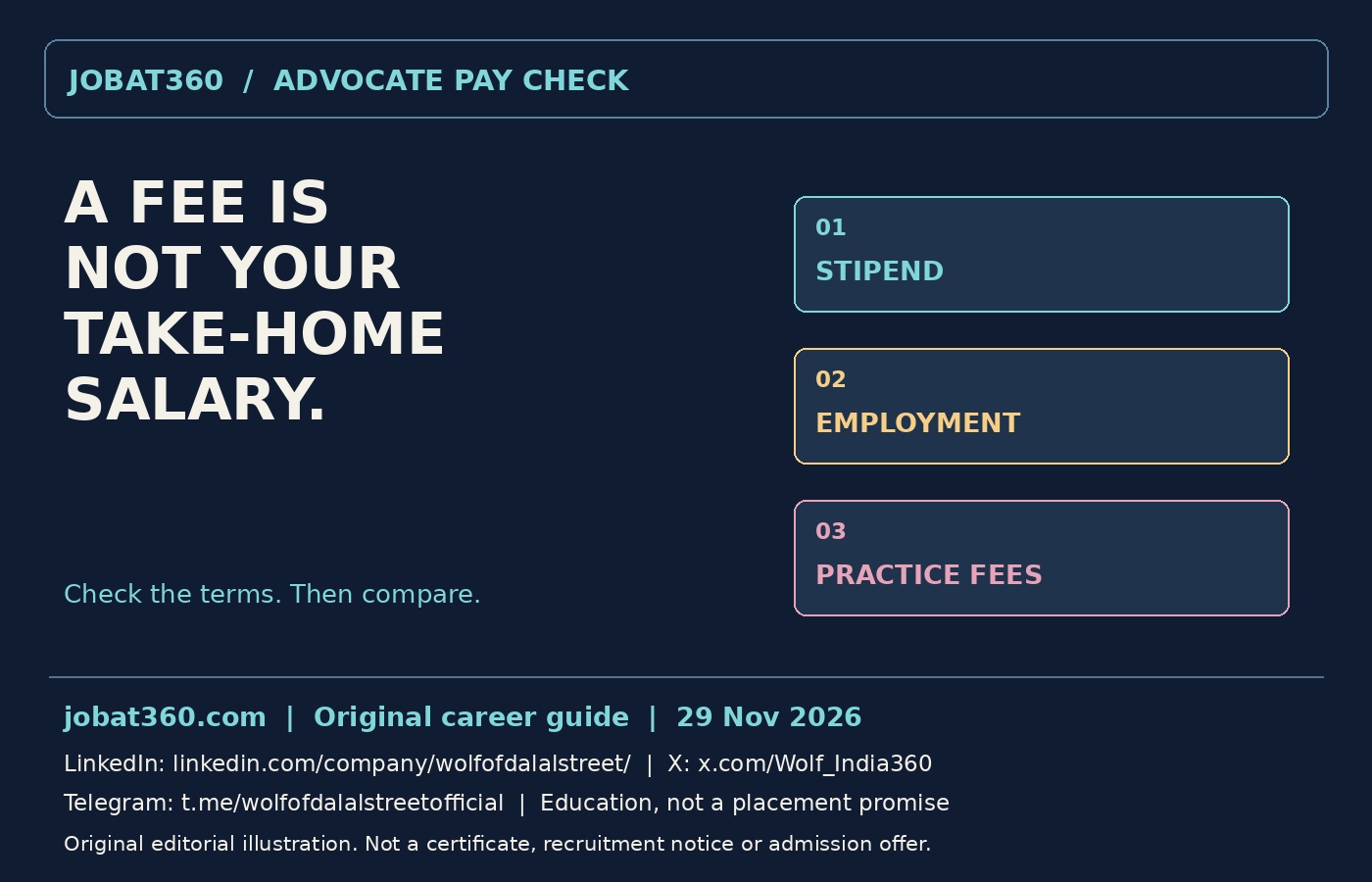
Four numbers that should not be treated as one salary
- Junior’s stipend: an amount agreed for assisting and learning within a chamber or other engagement. Check the engagement terms, payment date and any applicable local framework.
- Employment remuneration: pay for a defined role. Separate fixed cash, variable components, employer contributions and benefits. Also check the consequences for practising status.
- Retainer: a payment for an agreed scope or availability. Do not assume it includes unlimited drafting, appearances, travel and out-of-pocket expenses.
- Independent-practice fees: amounts billed or collected for professional work. They are not automatically personal take-home income, and billed amounts are not automatically cash received.
These are working distinctions for comparing offers, not legal classifications of a particular contract. The actual terms and applicable rules matter more than the label.
What the BCI stipend circular actually recommends
Bar Council of India Circular BCI:D:5383/2024, dated 15 October 2024, addresses junior advocates associated with or assisting advocates, senior advocates and law firms. It recommends a minimum monthly stipend of Rs 20,000 in urban areas and Rs 15,000 in rural areas, with a period of at least three years from engagement.
Read the qualification alongside the amounts. The circular describes its guidelines as directory, allows flexibility for differing financial circumstances and says implementation cannot be made mandatory across the board. Those figures should therefore not be presented as a universal, automatically enforceable national salary floor for every junior advocate.
The circular also calls for formal engagement letters setting out stipend terms, duration and mentorship; documented payments; and records of engagement and payment. It provides for grievances to the relevant State Bar Council while retaining flexibility for genuine financial constraints. A guideline being directory does not make a written payment promise unimportant, nor does it answer every question about a particular local rule or dispute.
A 6 February 2026 PIB account of a parliamentary answer repeats the recommended benchmarks and notes that some states have introduced stipend or financial-assistance measures through different mechanisms. State financial assistance and the amount a chamber agrees to pay are not necessarily the same payment. Check the official scheme’s eligibility, application, funding and payment conditions separately.
Local developments need their own check
The existence of the national circular does not settle the latest position in each state. For example, LiveLaw reported on 29 September 2026 that the Madhya Pradesh High Court directed local bodies to frame junior-advocate stipend guidelines within six months. That is reporting of a state-specific court development, not proof that a single national employment entitlement began on that date.
This guide has not verified the final implementation position of every state or the full order underlying that report. Before relying on a local entitlement or making a complaint, read the relevant order, current State Bar Council guidance and any applicable government scheme. Seek advice on your particular engagement if the position is disputed.
A real remuneration figure belongs to a real notice
The Supreme Court of India’s advertisement dated 20 January 2026 for Law Clerk-cum-Research Associates specified initial consolidated remuneration of Rs 1,00,000 per month for the 2026-2027 assignment term. It described a full-time, short-term contractual engagement, with no right to regular appointment or continued service.
The notice also barred taking another assignment and practising as an advocate in any court during the clerkship. This is a useful example precisely because its pay comes with a defined role and restrictions. It is not evidence that a newly enrolled advocate can expect the same income in a chamber, or that a Supreme Court clerkship is permanent government employment.
The advertisement’s application deadline was 7 February 2026, which is past as of this guide’s check date. It is used as a dated pay example, not an invitation to apply now. A future recruitment cycle can have different terms. Use the Court’s official recruitment page and current notice for any new application.
Older search results can still surface an earlier scheme or a prior year’s amount. Compare the document’s date and assignment term before repeating a figure. Do not silently convert a historical notice into today’s market average.
Why court-wise salary charts can mislead
A court’s name does not, by itself, establish an advocate’s remuneration. You need to know whether the person is employed, engaged on contract, retained by a client, appointed to a panel or running an independent practice. A government counsel’s fee schedule and a salaried post’s pay rules are different evidence.
For a public-sector opportunity, read the actual recruitment or empanelment notice. Check the eligibility, selection process, term, workload, payment basis, expense treatment and restrictions. Being listed on a panel is not, by itself, proof of a particular monthly flow of briefs or money. Do not infer guaranteed work from eligibility to be considered.
Likewise, a quoted appearance fee is not a monthly salary. Multiplying a headline fee by every working day assumes a volume of paid work and collection pattern that the figure alone cannot establish. This guide does not publish a court-by-court national salary ladder or a fixed earnings progression by years of practice.
Compare cash you can plan around
For a chamber engagement, ask for the amount, when payment starts, the payment date, review arrangements, expected working hours, court and office locations, and whether travel or other work expenses are reimbursed. Ask what research, drafting, filing, observation and feedback you will actually receive. Mentorship and financial support are separate questions; neither should remain a vague promise.
For a salaried legal role, request the written compensation breakdown. Annual CTC divided by twelve may include items that are not monthly bank credit. Ask which components are fixed, which are contingent, what deductions apply and what the employer’s documents say about probation, notice, benefits and outside work. This guide does not calculate individual tax or employment entitlements.
For a retainer or independent practice, distinguish amounts agreed, invoices raised, cash collected and expenses paid. Track the timing too. An unpaid invoice cannot fund this month’s rent. Money held for a client’s expenses is not automatically your fee income.
An invented planning example, not a market estimate
Suppose a junior has a written stipend of Rs 22,000 and expects Rs 6,000 of monthly travel and meals connected with the engagement. That leaves Rs 16,000 before other personal costs. Another opportunity mentions possible client fees but guarantees no monthly payment. The second opportunity cannot be treated as a higher fixed salary until its terms and likely cash flow are established.
Those numbers are invented to show the comparison method. They are not typical advocate pay, a statutory benchmark, a tax calculation or a recommendation to accept either arrangement.
Professional rules still apply to income plans
BCI’s published guidance on duties to clients says advocates should not charge based on the success of a matter or take a percentage of the amount or property received after success. Do not build a career-income plan around a generic “no win, no fee” or proceeds-sharing formula without checking the applicable professional rules.
The same guidance requires proper accounts of client money and distinguishes money received for fees from money received for expenses. Its guidance does not permit casually diverting expense money into fees. Clear scope, payment records and accounts protect the professional relationship as well as the budget.
Do not assume every advertised side income can be combined with active practice. The published professional framework addresses other employment, business and related activities. Before taking an in-house salaried job, a business role, teaching work or another engagement alongside practice, check your practising status, the applicable BCI and State Bar Council requirements and the actual contract. The legal treatment of a particular role needs its own assessment.
This is not a claim that every legal job has identical restrictions or that a job title alone decides the answer. The Supreme Court clerkship’s express restriction is one notice-specific example. An employment or professional-status question should not be answered by an earnings list.
Choose skills by the work, not a salary slogan
Research, drafting and clear writing are concrete things to assess when choosing training or early work. The Supreme Court’s 2026 clerkship notice, for example, expressly sought research and analytical skills, writing ability and computer-based legal information retrieval. That establishes what that notice sought, not a guarantee that a course teaching those skills will secure selection.
For a chamber opportunity, ask who will review your drafts and how often. For a contracts role, ask what kinds of documents you would handle. For litigation support, ask how preparation, filing and court work are divided. These are Jobat360’s suggested interview questions, not universal recruitment criteria.
Build an honest work sample using a fictional or publicly available problem. Do not publish confidential client files to demonstrate experience. A certificate or a prestigious practice label does not replace evidence of work, and no course in this guide is endorsed as a route to a guaranteed package.
A short record before you say yes
- Arrangement: stipend, salary, contract, retainer, panel or independent fees? Who is responsible for payment?
- Money: fixed amount, contingent amount, timing, deductions and expense treatment. What is documented rather than only discussed?
- Work: location, hours, duties, supervision, training, outside-work conditions and any professional-status implications.
- Duration: start, end, review, notice and what happens if the engagement is cut short.
- Evidence: engagement or offer letter, current official notice if relevant, local stipend scheme or order if relied upon, and a record of payment.
Do not pay an unknown recruiter to secure an alleged chamber placement or government legal appointment on the strength of a salary screenshot. Verify the opportunity through the actual chamber, employer or official recruitment route.
Common questions
What is the monthly salary of an advocate in India?
There is no single number established by the documents checked for this guide. A junior stipend, a specific legal job and independent fees cannot responsibly be collapsed into one expectation. Use a current written offer or official notice for the arrangement you are considering.
Is the BCI’s Rs 20,000 recommendation mandatory everywhere?
The 15 October 2024 circular recommends Rs 20,000 in urban areas and Rs 15,000 in rural areas, but expressly describes a directory and flexible framework rather than mandatory implementation across the board. Check later and local rules or orders before drawing conclusions about an individual entitlement.
Does working at the Supreme Court mean a guaranteed high salary?
No. The 2026-2027 clerkship advertisement had a specific consolidated amount for a specific contractual assignment, a closed application deadline and its own selection requirements. It is not a universal salary for lawyers practising before that court.
Who earns more: a CA or an advocate?
A qualification label is not a pay comparison. Compare like-for-like roles, experience, location, fixed and variable pay, hours, benefits and uncertainty. This guide has no matched dataset that would justify declaring one profession financially superior.
Can an advocate earn Rs 1 crore a month?
This guide does not verify individual high-earner claims. Even a genuine exceptional fee would not establish a representative or attainable monthly income for a new entrant. Plan around documented terms and costs, not an outlier headline.
Is law a good career, and is the study easy?
Those are personal-fit questions rather than salary facts. Try a small research-and-writing exercise, speak with people doing the work you are considering and examine its training and financial demands. No guaranteed income or effortless study path follows from choosing law.
Sources and scope
Checked 29 November 2026. The Chegg article and FAQ supplied the topic and questions; its national, court-wise and specialist salary ranges are not repeated as verified averages. Primary official documents support the stipend recommendation, dated clerkship example and professional-conduct cautions. Independent reporting supplies implementation context, with its limits identified. This is career information, not individual legal, tax or employment advice.
- Chegg India: advocate salary topic and FAQ, dated 15 July 2025.
- BCI circular BCI:D:5383/2024, 15 October 2024, read on the live BCI page.
- PIB: Stipend Scheme to Junior Lawyers, 6 February 2026, reporting the parliamentary answer.
- Supreme Court: official recruitment index.
- Supreme Court law-clerk advertisement, 20 January 2026, for 2026-2027. Application deadline 7 February 2026 is past.
- BCI: duties towards the client, including fees and accounts.
- Karnataka State Bar Council: published BCI professional-rules text. Specific employment and practising-status questions require checking applicable rules and advice, not relying on a general web summary.
- The Indian Express: stipend recommendation and implementation concerns, February 2026, independent reporting.
- LiveLaw: Madhya Pradesh stipend-guideline direction, 29 September 2026. Reported context, not independent verification of the full order or final local implementation.
Disclosure: For information and education only, not investment advice. We are not a SEBI-registered analyst. Double-check original sources before financial decisions. We hold zero shares in companies mentioned in this article. We do not take or promote positions on misleading price information for personal gain, or use this platform to mislead traders or investors. Our purpose is financial literacy and access to information, without a personal or monetary motive behind the information shared.
FOLLOW WOLF OF INDIA, FREE EVERYWHERE
WEBSITES
Wolf of Dalal Street: https://wolfofdalalstreet.com
Stockmarket360: https://stockmarket360.in
BizTechIndia: https://biztechindia.com
Jobat360: https://jobat360.com
Trending on Net: https://trendingonnet.com
Blog + daily digest: https://wolfofdalalstreetofficial.blogspot.com and https://wolfofindia.blogspot.com
APP
Free news app: https://wolfnews.surge.sh (turn on notifications)
YOUTUBE
Wolf of Dalal Street: https://www.youtube.com/@WOLFOFINDIA360
CHANNELS (free updates by message, our newsletter)
WhatsApp channel: https://whatsapp.com/channel/0029VaswZ107YSdBnLu1FY3g
Telegram (Wolf of Dalal Street): https://t.me/wolfofdalalstreetofficial
Telegram (Stockmarket360): https://t.me/stockmarket360official
Telegram (BizTechIndia): https://t.me/biztechindia
Telegram (Trending Online): https://t.me/Trendingonlineofficial
WhatsApp Business (join, message preferred): https://wa.me/919619991645
PERSONAL CONTACT
Personal Telegram contact (Kiran Sheth): https://t.me/WOLFOFINDIA
PROFILES
LinkedIn: https://www.linkedin.com/company/wolfofdalalstreet/
Instagram: https://www.instagram.com/wolfofindiaofficial
Facebook: https://facebook.com/wolfofdalalstreetofficial
X: https://x.com/Wolf_India360
Reddit community: https://www.reddit.com/r/WOLFOFDALALSTREETJOIN/
Quora Space: https://wolfofdalalstreet.quora.com
Diigo: https://www.diigo.com/user/wolfdalalstreet
RSS FEEDS
https://wolfofdalalstreet.com/feed/ | https://stockmarket360.in/feed/ | https://biztechindia.com/feed/ | https://jobat360.com/feed/ | https://trendingonnet.com/feed/ | https://wolfofdalalstreetofficial.blogspot.com/feeds/posts/default
Market and business education only. Not investment advice. No tips, no targets.