Career guide | Checked 29 November 2026
A management consultant helps an organisation make and carry out better decisions. The useful output is not a confident presentation by itself. It is a clear problem, evidence that can survive questions, a workable recommendation and a way to see whether the change helped.
You do not need to treat an MBA, a short certificate or a famous employer’s logo as the definition of this career. Start with the work and the entry requirements of the particular role. Employer pages checked for this guide show undergraduate entry routes, but they do not establish that every Indian office is recruiting, or that one degree guarantees selection.
What does a management consultant actually do?
The work can include research, interviews, financial or operational analysis, recommendations, implementation and follow-up. McKinsey’s Business Analyst description, job 15136, describes a client-service workstream using research, data analysis and interviews, with support for implementation. Its current wording typically asks for an undergraduate degree with less than four years of experience, while warning that country and practice requirements vary. The locations displayed when checked did not establish an India opening. Use it here as evidence of the job’s work and one employer’s general requirements, not an India vacancy announcement.
A consultant is not necessarily external. The US Bureau of Labor Statistics describes both internal management analysts and contractual consultants. That is useful occupational context, not an Indian recruitment rule. An internal strategy or operations team can do similar problem-solving work while having a different title and reporting line.
From a vague complaint to a usable decision
Consider an invented example: a retailer says profits are falling and asks whether it should cut prices. A sensible work plan would first separate falling sales from rising product costs, delivery costs, returns and discounting. It would test the data before choosing a remedy. This is an illustration, not a client case or a claim about guaranteed results.
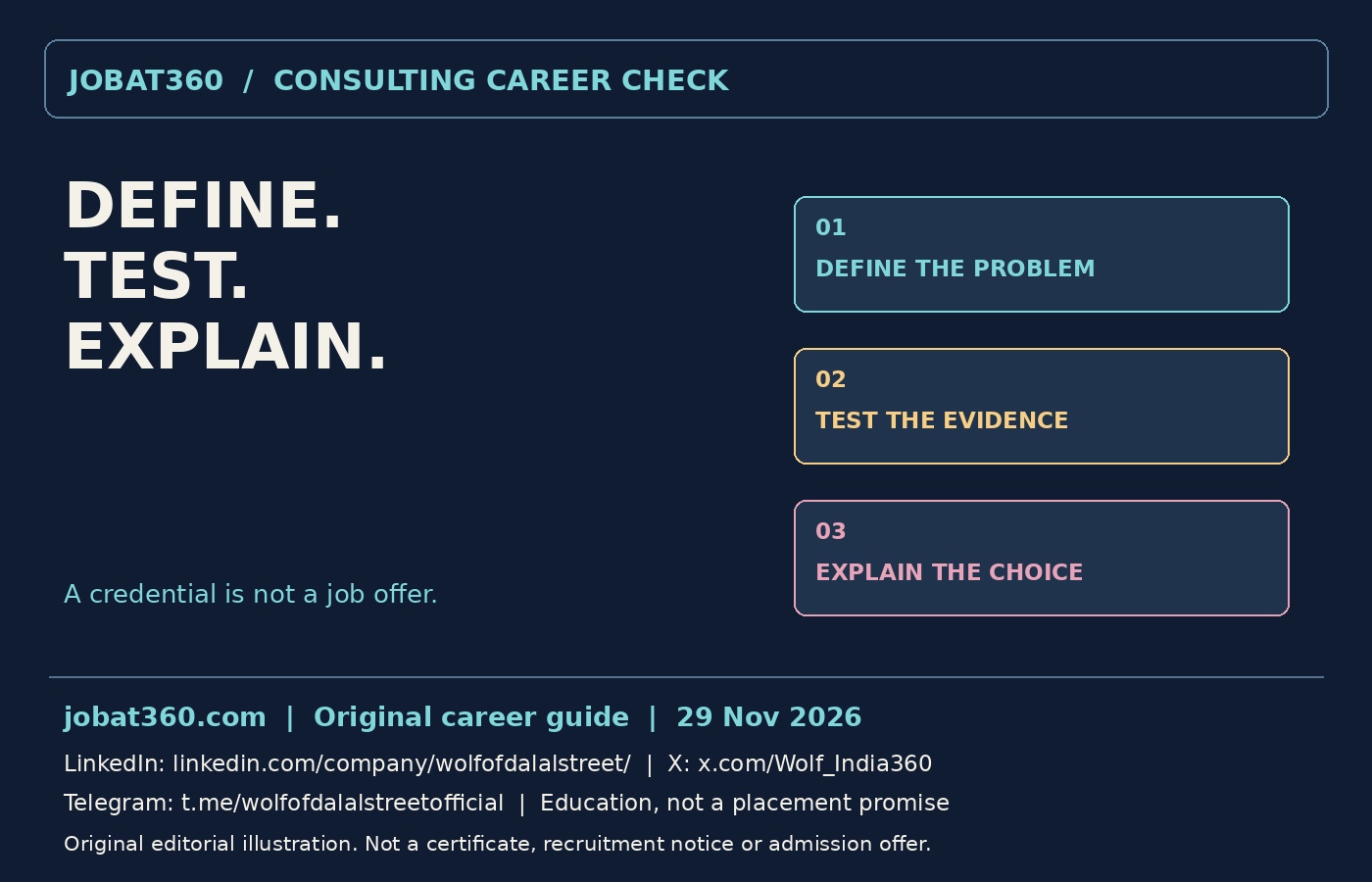
- Define the decision. Is the client choosing a price, a supplier, a process or a new market? Record the deadline, constraints and person who can approve the change.
- Check the baseline. Agree on definitions and period. Revenue is not profit, an order is not necessarily a completed sale, and an average can hide a problem in one product or location.
- Test explanations. Compare segments, interview the people doing the work and check whether the evidence supports the proposed cause.
- Compare options. Show costs, risks, dependencies and what remains uncertain. A recommendation should explain why another plausible option was rejected.
- Help the change happen. Set out an owner, timetable and test. Monitor the agreed measure rather than declaring success because a slide deck was delivered.
Types of consulting and scope
These are useful ways to sort the work, not a universal set of job titles. Read the team description and actual responsibilities.
- Strategy: choices about markets, products, growth or business direction.
- Operations: processes, service delivery, capacity, supply chains or cost control.
- Technology and digital change: business requirements, systems adoption and changes to how people work with tools. Some roles need deep technical expertise; a general strategy background does not supply it.
- People and organisation: structure, workforce processes, incentives and change adoption.
- Finance and risk: analysis supporting financial or risk decisions. Check the precise remit and required professional qualifications. A consulting title is not a substitute for qualifications needed for regulated work.
- Industry-specialist work: applying experience in a sector to a defined business problem.
ICMCI’s CMC competence description spans human resources, strategic planning, finance, operations, IT and marketing, alongside ethics, consulting processes, change, communication and project management. No one starting role necessarily covers all these areas. Scope depends on the assignment.
Can you enter without an MBA?
Yes, some routes do not require an MBA. Bain’s Associate Consultant hiring page addresses undergraduates and professionals a few years out of college. It asks for a CV, education and work-experience information and relevant test scores, with additional requirements depending on the office. McKinsey’s general Business Analyst description also lists an undergraduate route. Neither page means every degree holder qualifies for every office or intake.
An MBA may be relevant for a different hiring track, a career change or a particular employer. Before paying for one, compare its total cost and the actual roles you want with their current requirements. Do not borrow on the assumption that admission equals a consulting offer. This guide is about entering the profession; our separate management-consultant courses guide covers how to assess learning options.
Build evidence of skills, not a list of buzzwords
- Analysis: organise messy data, explain missing values and check whether a conclusion changes when an assumption changes.
- Problem-solving: break a question into testable parts instead of forcing a memorised framework onto it.
- Communication: write a short recommendation that separates facts, assumptions and unanswered questions. Explain the trade-off aloud.
- Business understanding: understand the customer’s problem and the organisation’s costs, revenue and operating constraints.
- Project delivery: plan the work, track dependencies, meet deadlines and raise problems early.
- Relationships and integrity: listen to people who disagree, protect confidential information and state your contribution honestly.
McKinsey’s current description specifically mentions written outputs, PowerPoint decks and Excel models, alongside rational decision-making, communication and time management. Tools help express the analysis; knowing the tool is not the same as knowing what the evidence means.
A practical entry plan
- Choose a role family. Compare client-facing generalist consulting, implementation, a sector-specialist team and an internal analysis role. Similar titles can hide different work.
- Read several live employer descriptions. Record the office, degree requirements, experience, work rights, travel and application route. Recheck the page immediately before applying.
- Make one honest work sample. Use public or invented data to answer a narrow business question. Include a short memo, an analysis file and the limitations. Label invented data clearly.
- Get relevant experience. A real internship, research project, operational job or voluntary project can give you examples to discuss. Describe the tasks you actually did, not the responsibilities of the whole team.
- Prepare for the stated selection process. Practise explaining your reasoning and your own experience. Ask the recruiter what assessments apply to that role.
- Apply through the employer’s current route. Networking can help you understand a team. It does not replace eligibility or guarantee an interview.
One check illustrates why this matters: a search result surfaced McKinsey’s Associate Analyst – Finalta, job 105354, with a Gurugram description. Its live employer page stated that the position was no longer available. This guide does not promote it as an open job. A detailed search excerpt can outlive a vacancy.
Interview preparation and AI
McKinsey says most client-facing roles involve personal-experience and problem-solving interviews, with expertise interviews for some roles; the recruiter confirms the details. Its page discusses Solve for most consulting roles and separate technical assessments where relevant. Do not assume that every firm uses that process.
Prepare truthful examples of a decision, a disagreement, a difficult deadline and a result you can explain. In a case discussion, clarify the question, state assumptions and adjust when new evidence arrives. McKinsey permits responsible AI use for preparation such as understanding concepts or polishing a CV, but does not allow invented achievements, live AI-generated interview answers, or AI during assessments unless specifically permitted. Follow each employer’s own rules, not a coaching service’s promise of an interview shortcut.
Salary: why there is no reliable single ladder here
The topic reference mixes Indian salary bands, dollar-denominated examples and different seniority labels. They do not establish one comparable India-wide pay scale. The employer descriptions checked for this guide do not establish an Indian salary average or a highest-paid consultant. We therefore do not repeat those figures as a promise.
Compare actual offers using fixed annual pay, variable pay and its conditions, one-time payments, employer contributions, location, travel reimbursement and any repayment clauses. CTC is not monthly take-home pay. A self-employed consultant’s billed fee is not salary: unpaid time, costs and collections matter.
US Bureau of Labor Statistics pay and outlook data describe a US occupation and a particular reporting period. They are not Indian salary or hiring forecasts. The reference article’s older US growth claim should not be used as evidence that a particular Indian graduate will find a job.
Growth, benefits and the less attractive parts
Responsibilities may grow from analysis on a workstream to leading a team, managing a client relationship and winning business. Titles and promotion rules vary; partner is not a guaranteed destination after a fixed number of years. The US occupational handbook describes senior analysts supervising projects and potentially moving into partnership or management elsewhere, but that is a possible path, not a commitment by an Indian employer.
The appeal can be varied problems, feedback, teamwork and exposure to different organisations. The cost can include tight deadlines, travel, competing priorities and uncertain project assignments. McKinsey’s description explicitly includes work or meetings outside traditional hours and travel to varied environments. Ask how those requirements work for the particular team, including how expenses and time away are handled.
Is CMC certification required to start?
Do not confuse a professional designation with an entry-level course certificate. ICMCI describes Certified Management Consultant as a competence-based designation administered through member institutes. Its linked additional prerequisites include three years in management consulting, relevant current activity and membership conditions. Those requirements make it a different proposition from a beginner’s short course. Check the relevant institute’s current assessment route. This is not a claim that CMC is a legal requirement for all consulting jobs or that the designation alone secures employment.
Frequently asked questions
What is a management consultant and what do they typically do?
A person helping an organisation improve decisions and performance through research, analysis, recommendations and, depending on the assignment, implementation and follow-up. Internal consulting roles exist as well as external firms.
What are the main responsibilities in management-consultant jobs?
Define the problem, gather and check evidence, test explanations, compare options, communicate recommendations and help track the agreed change. The mix differs by team, seniority and project.
Who are the Big Four?
Deloitte, EY, KPMG and PwC. ICAEW uses the term for the largest accountancy firms and describes consultancy among the services larger firms provide. It is not a ranking of the four best consulting jobs, and it does not mean all their roles are management consulting.
What skills are needed?
Structured analysis, clear writing and speaking, business understanding, teamwork, time management and sound judgement. Technical and industry requirements depend on the assignment. Show examples rather than listing skills without evidence.
Is management consulting a high-paying job?
Some offers can be attractive, but the title alone cannot tell you the package or hours. No verified India-wide salary average was established in this review. Compare a written offer’s fixed, variable and one-time components before deciding.
Who are the top three management consultants?
The source’s question refers to McKinsey, Boston Consulting Group and Bain, often grouped as MBB. That shorthand is not an objective ranking or a reason to ignore specialist, internal or other consulting teams. Judge a particular job by its work and fit.
Who is the highest-paid consultant?
This review did not establish a defensible ranking of individual consultants’ earnings. Private partnership income, employment pay and an independent consultant’s advertised hourly fee are not interchangeable measures.
What is the average management-consultant salary?
There is no single average verified here for India across firms, experience levels and job types. A salary statistic needs a named dataset, date, sample and definition. Do not turn a salary range from a career blog into an expected offer.
Can I become a management consultant without an MBA?
Some employer routes accept undergraduates or early-career professionals. Check the current office-specific rules. A degree, work sample or referral alone does not guarantee selection.
Sources and reading notes
The Chegg article and its full FAQ supplied the topic checklist, not text to reproduce or verified salary promises. Employer and professional sources below were read on 29 November 2026. Availability and hiring requirements can change.
- Chegg India: management consultant topic reference, page dated 2 December 2024 despite the 2025 title.
- McKinsey Business Analyst, job 15136: role, typical requirements and work conditions; not verified as an India opening.
- Bain Associate Consultant hiring process: general entry route and office-specific application caveat.
- McKinsey interviewing: assessments, interview preparation and AI integrity rules.
- McKinsey Associate Analyst – Finalta: no longer available at the time of the check.
- ICMCI: CMC and additional prerequisites, version 2.0: professional designation and experience conditions.
- ICAEW: accountancy firms: Big Four terminology.
- US Bureau of Labor Statistics: Management Analysts: occupational context only, not Indian wages or an India hiring projection.
Bottom line: choose a real role, learn its requirements and show how you reason from evidence. A credential can support that work; it cannot do the work or promise an offer for you.
Disclosure: For information and education only, not investment advice. We are not a SEBI-registered analyst. Double-check original sources before financial decisions. We hold zero shares in companies mentioned in this article. We do not take or promote positions on misleading price information for personal gain, or use this platform to mislead traders or investors. Our purpose is financial literacy and access to information, without a personal or monetary motive behind the information shared.
FOLLOW WOLF OF INDIA, FREE EVERYWHERE
WEBSITES
Wolf of Dalal Street: https://wolfofdalalstreet.com
Stockmarket360: https://stockmarket360.in
BizTechIndia: https://biztechindia.com
Jobat360: https://jobat360.com
Trending on Net: https://trendingonnet.com
Blog + daily digest: https://wolfofdalalstreetofficial.blogspot.com and https://wolfofindia.blogspot.com
APP
Free news app: https://wolfnews.surge.sh (turn on notifications)
YOUTUBE
Wolf of Dalal Street: https://www.youtube.com/@WOLFOFINDIA360
CHANNELS (free updates by message, our newsletter)
WhatsApp channel: https://whatsapp.com/channel/0029VaswZ107YSdBnLu1FY3g
Telegram (Wolf of Dalal Street): https://t.me/wolfofdalalstreetofficial
Telegram (Stockmarket360): https://t.me/stockmarket360official
Telegram (BizTechIndia): https://t.me/biztechindia
Telegram (Trending Online): https://t.me/Trendingonlineofficial
WhatsApp Business (join, message preferred): https://wa.me/919619991645
PERSONAL CONTACT
Personal Telegram contact (Kiran Sheth): https://t.me/WOLFOFINDIA
PROFILES
LinkedIn: https://www.linkedin.com/company/wolfofdalalstreet/
Instagram: https://www.instagram.com/wolfofindiaofficial
Facebook: https://facebook.com/wolfofdalalstreetofficial
X: https://x.com/Wolf_India360
Reddit community: https://www.reddit.com/r/WOLFOFDALALSTREETJOIN/
Quora Space: https://wolfofdalalstreet.quora.com
Diigo: https://www.diigo.com/user/wolfdalalstreet
RSS FEEDS
https://wolfofdalalstreet.com/feed/ | https://stockmarket360.in/feed/ | https://biztechindia.com/feed/ | https://jobat360.com/feed/ | https://trendingonnet.com/feed/ | https://wolfofdalalstreetofficial.blogspot.com/feeds/posts/default
Market and business education only. Not investment advice. No tips, no targets.