A price rise at one shop is not, by itself, a measure of inflation across an economy. Both observations matter, but they answer different questions. Microeconomics examines choices and interactions involving households, firms and particular markets. Macroeconomics examines economy-wide outcomes such as output, employment and the general price level.
The distinction is about the question and level of analysis, not whether a company is physically small or a topic sounds important. A global industry can be studied with microeconomic tools. A household decision can be affected by macroeconomic conditions. This beginner guide uses fictional examples, not current economic forecasts or investment recommendations.
Ask what you are trying to explain
Suppose a fictional neighbourhood repair shop raises its service charge. A microeconomic investigation might ask whether spare-parts costs rose, whether customers have alternatives, whether demand changed or whether the shop is operating near capacity. It would need evidence about that service and its market.
A macroeconomic investigation might instead ask whether prices are rising broadly, how production is changing across the economy or what is happening to overall employment. It needs aggregate measures, with definitions, coverage and dates. The shop’s experience may contribute to that bigger picture, but one shop cannot stand in for the entire economy.
The IMF’s introduction to the two fields makes an important qualification: microeconomic markets can cross national borders. A study of competition in an international market does not become macroeconomics merely because several countries are involved.
Microeconomics: choices, incentives and markets
Typical microeconomic questions concern what people buy, what firms produce, how prices and quantities respond to conditions, and how market rules affect outcomes. Competition, market power, information and constraints can matter. The analysis is not limited to a business’s internal costs.
For the repair shop, first distinguish a change in the price customers face from a change in their willingness to buy at every possible price. If the service price falls and more customers book, that can be a movement along a demand curve. If a new regulation makes the service more valuable to customers at each price, that can shift demand. These are different model changes.
CORE Econ’s supply-and-demand discussion explains this distinction using explicitly stated market assumptions. A diagram is a way to organise reasoning. It is not evidence that every real market adjusts instantly, that competition is perfect or that only one influence changed.
Macroeconomics: aggregates and their limits
Macroeconomic analysis studies relationships among measures such as total output, inflation, employment and economy-wide spending. It also examines fiscal policy, involving government spending and taxation, and monetary policy, involving central-bank tools. This article does not state any current policy rate, inflation target or forecast.
GDP and gross value added are related but not interchangeable. MoSPI’s GDP FAQ explains GVA as production value after subtracting intermediate inputs. GDP is obtained by adding taxes on products and subtracting subsidies on products from the sum of GVAs. Simply adding every firm’s sales can count the same intermediate production more than once.
Always read the series definition and time period. Comparing different methods or series without checking their basis can produce a misleading growth story. MoSPI specifically notes the importance of consistent measurement methods and sources when comparing periods.
A fictional value-added chain
Consider a deliberately simplified closed production chain. A supplier produces materials worth Rs100 using no purchased intermediate inputs in this example. A workshop buys those materials and sells a finished item for Rs180. A retailer buys the item and sells it to its final user for Rs250. Assume no product taxes or subsidies, all production is domestic and in the same period, with no inventory changes or other intermediate inputs.
- Supplier value added: Rs100.
- Workshop value added: Rs180 minus Rs100 = Rs80.
- Retailer value added: Rs250 minus Rs180 = Rs70.
- Total value added: Rs250, not the Rs530 sum of all sales.
This is a teaching illustration of avoiding double counting, not a complete national-accounts calculation. Real accounts include more sectors, transactions and adjustments. Value added is also not identical to company profit: it is not the amount left after every wage and other relevant distribution or cost.
Lower inflation does not mean the old price level returns
Inflation describes a rate of price increase over a specified period. The IMF explains how a consumer price index tracks a basket rather than a single purchase. Households can experience different spending pressures because their budgets differ from the average basket.
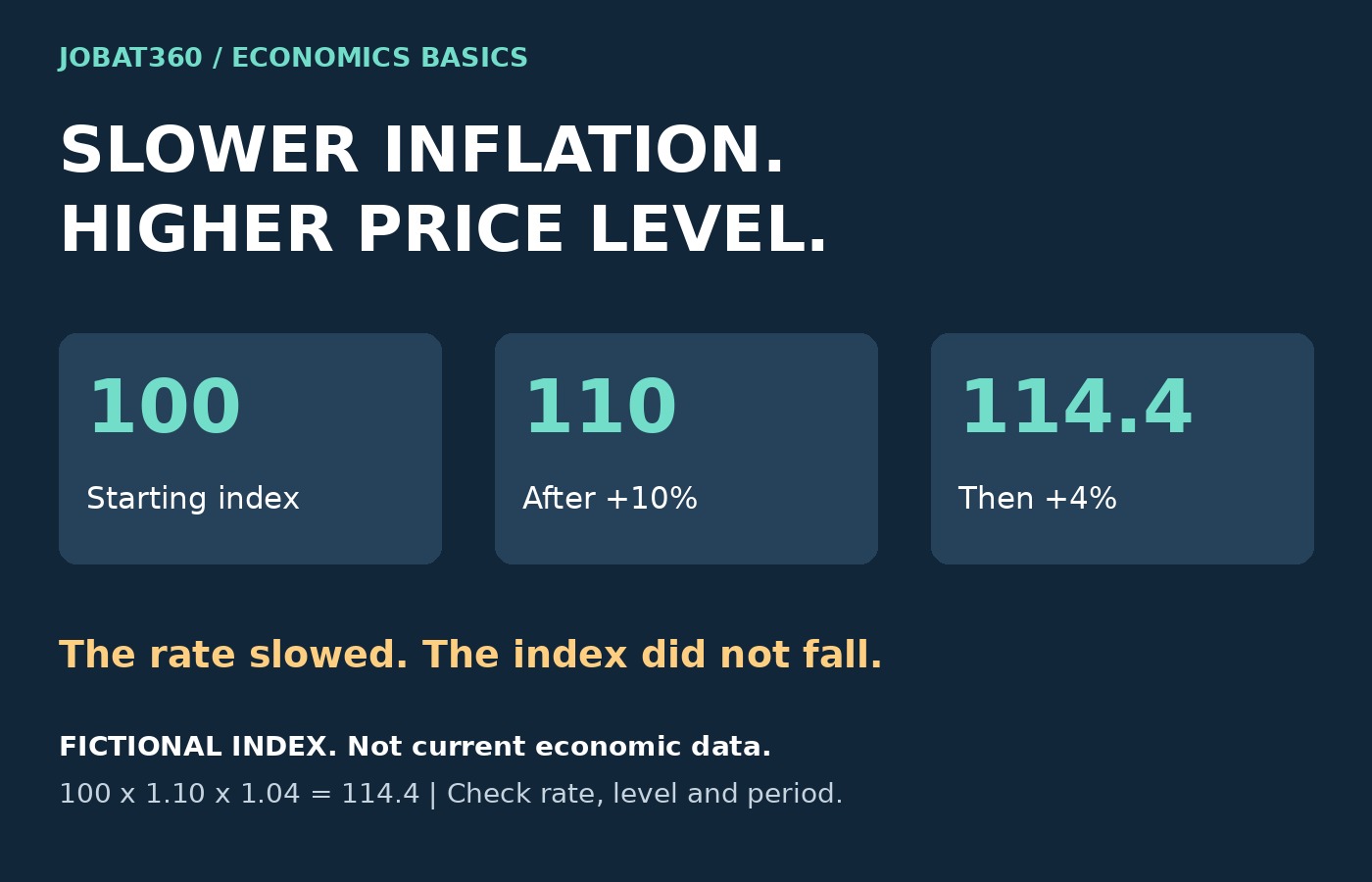
Use a fictional price index that starts at 100. A 10% increase takes it to 110. A subsequent 4% increase takes it to 114.4, calculated as 110 multiplied by 1.04. Inflation slowed from 10% to 4%, yet the price level rose again. This is slower inflation, not falling prices.
A fall from 110 to 105 would instead be a fall in that index’s price level over the specified comparison. Do not confuse a lower rate with a lower level, or assume that a national inflation reading describes the change in every individual bill.
GDP growth is not a promise about each person’s income
An aggregate can improve while some households or sectors struggle. The Bank of England’s GDP explainer notes that GDP does not show how evenly income is distributed and does not capture all valuable activity or every aspect of wellbeing. Its examples concern the UK; the general measurement caution is useful elsewhere without importing UK statistics into an Indian claim.
Likewise, higher sales at a particular firm do not establish that national output is rising. The firm may be gaining market share from competitors. A successful household decision may also have a different combined effect when many households make it together. The connection between individual choices and aggregate results needs an explanation, not an assumption.
Connect the levels through a mechanism
Instead of saying “the economy affects business”, trace a possible channel. A broad financing-cost change may affect a firm’s borrowing plans. Those plans may affect equipment purchases, capacity or hiring. The strength and timing depend on contracts, demand, financial conditions and other facts. A plausible channel is not proof that it caused an observed outcome.
Work in the other direction too. A disruption in a widely used input market can affect costs in several industries. Whether that becomes broad, persistent inflation requires more evidence than a price rise in the original market. State what data would support or weaken the explanation.
A study exercise that makes the distinction useful
- Choose a dated economic story and write its precise claim in your own words.
- Identify the unit of analysis: a household, firm, market or economy-wide measure.
- Record the source, geography, period and definition of each number.
- Write one possible mechanism and one alternative explanation.
- State what the evidence does not establish, including whether it says anything about individual outcomes.
For a small portfolio exercise, compare a fictional shop decision with a clearly labelled aggregate indicator. Keep invented inputs separate from real releases. Do not present this exercise as a professional qualification or as proof that a particular degree guarantees an analyst job.
Bottom line: micro and macro are connected perspectives. Name the question first, choose evidence at the right level and check whether you are comparing a rate, a level or an average. That habit is more useful than memorising “small versus big” alone.
Sources and scope, checked 27 November 2026
- Chegg India: Powerful Guide to Microeconomics and Macroeconomics Differences (2025), topic read in full. Source career anecdotes, course endorsements and broad employment promises are not reproduced.
- IMF Finance & Development: The Big and the Small Picture, the two levels of analysis and their connections. This is conceptual background, not a current forecast.
- CORE Econ: Changes in supply and demand, curve shifts versus movements under stated model assumptions.
- IMF Finance & Development: Inflation, Prices on the Rise, inflation measurement and the distinction between rates and purchasing power.
- Bank of England: What is inflation?, rate and price-level concepts. UK policy targets and current readings are not used as Indian facts.
- Bank of England: What is GDP?, GDP’s distribution and wellbeing limitations.
- MoSPI: Understanding the New Series of GDP, FAQs, GDP/GVA definitions and comparability. This article uses definitions, not a claim about the latest release or data revision status.
Jobat360 is an independent information publisher, not an education provider or placement agency. The numerical chains and price index are fictional learning examples. No job, earnings, investment or policy outcome is guaranteed.
Disclosure: For information and education only, not investment advice. We are not a SEBI-registered analyst. Double-check original sources before financial decisions. We hold zero shares in companies mentioned in this article. We do not take or promote positions on misleading price information for personal gain, or use this platform to mislead traders or investors. Our purpose is financial literacy and access to information, without a personal or monetary motive behind the information shared.
FOLLOW WOLF OF INDIA, FREE EVERYWHERE
WEBSITES
Wolf of Dalal Street: https://wolfofdalalstreet.com
Stockmarket360: https://stockmarket360.in
BizTechIndia: https://biztechindia.com
Jobat360: https://jobat360.com
Trending on Net: https://trendingonnet.com
Blog + daily digest: https://wolfofdalalstreetofficial.blogspot.com and https://wolfofindia.blogspot.com
APP
Free news app: https://wolfnews.surge.sh (turn on notifications)
YOUTUBE
Wolf of Dalal Street: https://www.youtube.com/@WOLFOFINDIA360
CHANNELS (free updates by message, our newsletter)
WhatsApp channel: https://whatsapp.com/channel/0029VaswZ107YSdBnLu1FY3g
Telegram (Wolf of India): https://t.me/WOLFOFINDIA
Telegram (Wolf of Dalal Street): https://t.me/wolfofdalalstreetofficial
Telegram (Stockmarket360): https://t.me/stockmarket360official
Telegram (BizTechIndia): https://t.me/biztechindia
Telegram (Trending Online): https://t.me/Trendingonlineofficial
WhatsApp Business (join, message preferred): https://wa.me/919619991645
PROFILES
LinkedIn: https://www.linkedin.com/company/wolfofdalalstreet/
Instagram: https://www.instagram.com/wolfofindiaofficial
Facebook: https://facebook.com/wolfofdalalstreetofficial
X: https://x.com/Wolf_India360
Reddit community: https://www.reddit.com/r/WOLFOFDALALSTREETJOIN/
Quora Space: https://wolfofdalalstreet.quora.com
Diigo: https://www.diigo.com/user/wolfdalalstreet
RSS FEEDS
https://wolfofdalalstreet.com/feed/ | https://stockmarket360.in/feed/ | https://biztechindia.com/feed/ | https://jobat360.com/feed/ | https://trendingonnet.com/feed/ | https://wolfofdalalstreetofficial.blogspot.com/feeds/posts/default
Market and business education only. Not investment advice. No tips, no targets.