A budget allocation is a plan for spending, not proof that a public service has been delivered. Public finance studies how governments raise resources, choose spending priorities, manage borrowing and account for the results. It is useful for students interested in economics, accounting, public policy or research, and for anyone trying to read a budget headline carefully.
Start with the question behind the number. Is it a proposed allocation, a revised estimate, recorded expenditure, an outstanding liability or a measured outcome? Those are different things. This guide uses fictional arithmetic and official definitions, not current tax advice, a forecast or a recommendation to buy a course.
What public finance includes
Revenue concerns the resources a government collects. Expenditure concerns how it spends. Borrowing and debt concern financing and obligations. Financial administration includes the budget process, accounts, controls and audit. The subject also asks who benefits, who bears costs and whether public money achieves its intended purpose.
Public finance is broader than choosing a tax rate. It can involve the funding of public services, distribution across groups and regions, and the way fiscal decisions interact with the wider economy. The IMF defines fiscal policy as the use of government spending and taxation to influence the economy. Its effects depend on circumstances, timing, composition and financing constraints.
A government budget should not be treated as identical to a household budget. Governments have public responsibilities and powers that households do not, and their decisions can affect aggregate economic activity. That difference does not remove financing constraints or the need to account for obligations.
Revenue, receipts and borrowing are not interchangeable
Budget documents distinguish revenue receipts from capital receipts. Revenue receipts include tax and non-tax receipts. Capital receipts include borrowing as well as non-debt items such as loan recoveries or proceeds from disinvestment. Read the exact classification in the document rather than calling every inflow tax income.
Borrowing provides resources but also creates an obligation. If a total-receipts figure includes borrowing, subtracting it from expenditure will not reveal the fiscal deficit in the way a beginner might expect. You must exclude the relevant debt receipts in accordance with the official definition.
Likewise, selling an asset is not the same as collecting a recurring tax. When assessing a funding plan, ask whether an inflow can recur, whether it changes assets or liabilities, and whether the comparison uses the same coverage across years.
Three deficit measures, three questions
The Ministry of Finance’s Budget at a Glance for 2026-27 provides these definitions. The Indian Economic Service’s Arthapedia explanation also distinguishes the measures. Use the current budget’s stated presentation when doing a specific calculation.
- Fiscal deficit: total expenditure minus total receipts excluding debt capital receipts. The budget describes it as reflecting the government’s overall borrowing requirement.
- Revenue deficit: revenue expenditure minus revenue receipts.
- Primary deficit: fiscal deficit minus interest payments, as presented in Budget at a Glance.
These measures are not substitutes. A primary deficit removes interest payments from the fiscal-deficit measure; it does not mean interest payments cease to matter. A revenue deficit is not simply another name for the fiscal deficit.
A fictional budget you can check yourself
Assume a simplified budget with all figures in fictional Rs crore for one financial year. Revenue receipts are 800. Non-debt capital receipts are 50. Revenue expenditure is 900, including interest payments of 100. Capital expenditure is 200. There are no other items or adjustments in this teaching example.
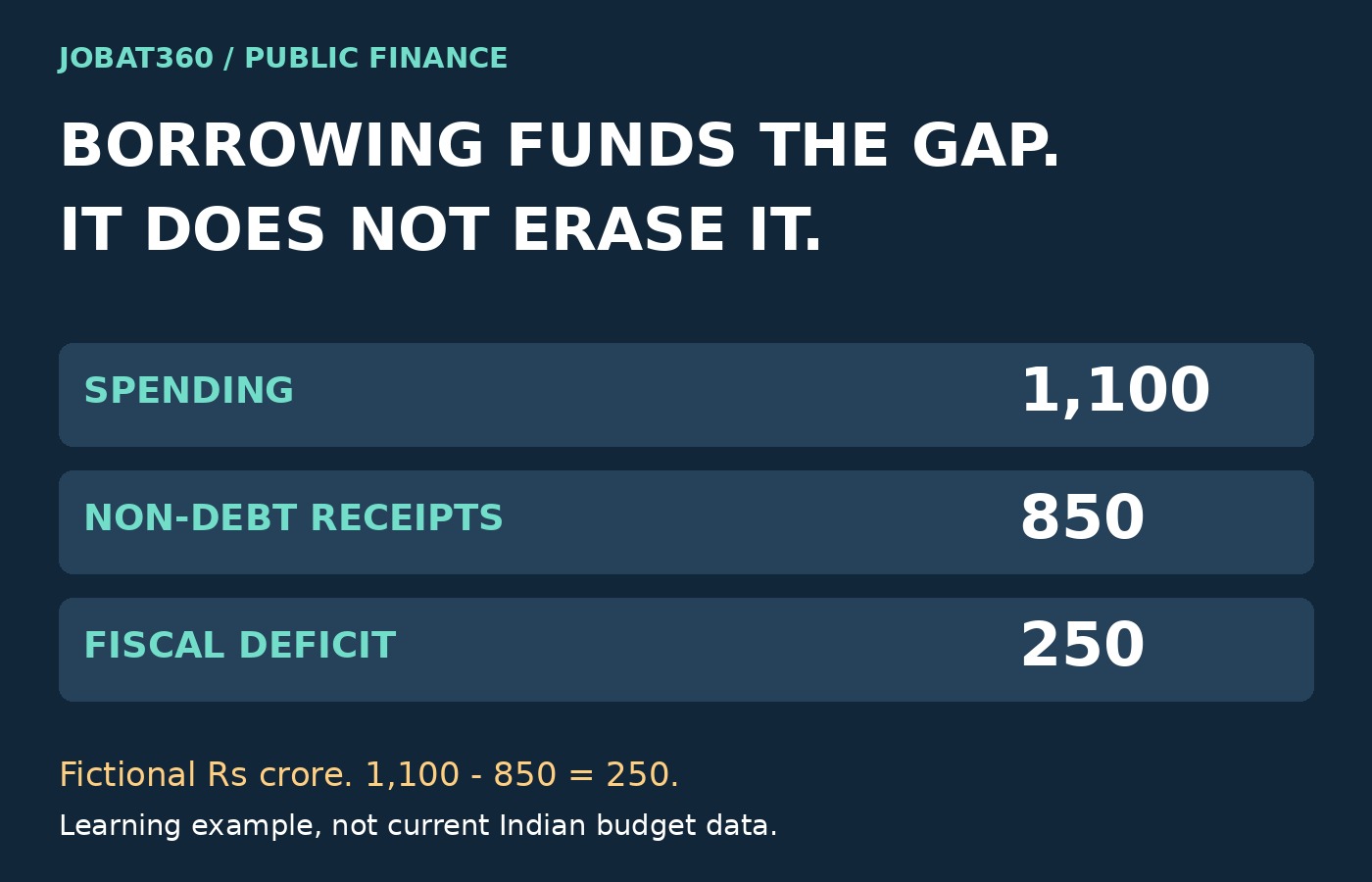
- Total expenditure: 900 + 200 = 1,100.
- Receipts excluding borrowing: 800 + 50 = 850.
- Fiscal deficit: 1,100 minus 850 = 250.
- Revenue deficit: 900 minus 800 = 100.
- Primary deficit: 250 minus 100 = 150.
Adding borrowing of 250 makes total financing resources equal the 1,100 expenditure in this simplified example. It does not make the fiscal deficit zero. The financing entry explains how the gap is covered.
These are not Indian budget figures. Real documents contain detailed classifications, reconciliations and notes. The current official Budget at a Glance also notes that some figures are net of receipts and recoveries and that rounding can affect totals.
A deficit is a flow; debt is a stock
A deficit measures a gap over a period. Outstanding debt measures an obligation at a point in time. A statement about one year’s deficit cannot, on its own, tell you the entire debt position, maturity structure or interest burden.
Always identify the government coverage. A Union government figure and a combined Centre-and-states figure are not the same measure. Also distinguish an amount in rupees from a percentage of GDP. A ratio has a numerator and a denominator, both of which matter to its movement.
This article does not state a current debt ratio, fiscal target or statutory compliance verdict. Those require the relevant year’s legal framework, fiscal statements and actual data, rather than a target copied from an older explainer.
Read the column heading before comparing two amounts
Official budget tables label figures as Actuals, Budget Estimates or Revised Estimates for particular financial years. A Budget Estimate is not a completed-spending figure. A Revised Estimate remains an estimate, not automatically the final audited result.
A fictional scheme might have a Budget Estimate of 100 and a Revised Estimate of 80 for the same year. That change does not by itself prove that the scheme finally spent 80, or explain why the estimate changed. A later Actuals figure may answer a different question. Also read the status note: the Controller General of Accounts labels its provisional actuals as unaudited. The word “actuals” alone does not prove that an audit is complete.
Before saying spending rose or fell, write the comparison explicitly: this year’s Budget Estimate against last year’s Budget Estimate, last year’s Revised Estimate, or an earlier Actuals figure? Those comparisons can produce different percentages. Use the same units and explain any change in scheme coverage.
Spending classification is not a quality score
Capital and revenue expenditure help describe the nature of a transaction. They do not, by themselves, tell you whether a project is useful or well run. A school building needs teachers and maintenance to deliver education. A new asset is not automatically valuable simply because it appears under a capital heading.
There is a further classification caution in the Union Budget: effective capital expenditure adds capital expenditure and grants-in-aid for creation of capital assets. It is a separately defined measure. Do not silently replace ordinary capital expenditure with effective capital expenditure in a year-to-year comparison.
For a claim about results, look beyond the allocation. Was the money authorised, released and spent? What was built or provided? Who could use it? What changed for users? Each step needs its own evidence. A low spending figure alone does not establish either efficiency or failure.
Accountability does not end on Budget day
The CAG’s explanation of legislative financial committees describes two stages of control: consideration of proposed receipts and expenditure, and review of how approved resources were used. Accounts and audit reports help examine whether spending conformed to its authority and whether implementation achieved its objectives.
The PRS primer on scrutiny of public funds is useful for understanding the oversight process and finding the right documents. Its older numerical examples should not be mistaken for current budget data. Start with a current official document for the figure, then use accounts, audit findings and committee material for the question you are investigating.
Turn the subject into a small study project
Choose one budget line or programme rather than trying to explain the whole economy at once. Create a source sheet containing the document title, issuing body, financial year, column type, units, page or table and exact definition. Keep copied figures separate from your own calculations.
- Write a narrow question, such as how the estimate changed for the same programme.
- Check that the compared figures use compatible coverage and units.
- Recalculate the difference and percentage, keeping the denominator visible.
- Find any relevant explanation in official notes or oversight material.
- State what remains unknown, especially actual delivery and outcomes.
For career exploration, this exercise can demonstrate careful reading, arithmetic, documentation and clear writing. It does not qualify you for every role labelled public finance. Research, audit, accounting, taxation and government service can have different entry routes and formal requirements. Check the institution’s current programme notice or employer’s official recruitment notice before choosing a qualification.
Bottom line: follow the money through its stages. A receipt is not always revenue, borrowing is not income without an obligation, a deficit is not the entire debt stock, and an allocation is not an outcome. Good public-finance analysis makes those distinctions visible.
Sources and scope, checked 28 November 2026
- Chegg India: Public Finance, full topic and FAQs read. This original guide does not repeat source salary estimates, unverified course claims, old fiscal targets or unrelated corporate-law passages.
- IMF: What Is Fiscal Policy?, conceptual background and the importance of timing, financing and circumstances. Its crisis-era examples are not presented as current conditions.
- Indian Economic Service, Arthapedia: Deficit Measurement in India, distinctions among deficit measures. Current presentation is checked against the budget below.
- Ministry of Finance: Budget at a Glance, 2026-27, deficit and effective-capital-expenditure definitions, table headings and notes. This article’s arithmetic is fictional, not a reproduction of its budget totals.
- PRS Legislative Research: Overseeing Public Funds, budget-document navigation and scrutiny, not current numerical claims.
- Comptroller and Auditor General of India: Legislation Committees, legislative scrutiny and financial accountability.
- Ministry of Finance: Key to Budget Documents, 2026-27, revenue and capital classifications and the purpose of the budget documents.
- Controller General of Accounts: provisional accounts for 2025-26, distinction between revised estimates and unaudited provisional actuals. No current totals are reproduced.
- IMF: How to Check Integrity of Fiscal Data, stocks, flows and the need to reconcile changes in debt with financing.
Jobat360 is an independent information publisher, not a training provider, recruiter or tax adviser. No course admission, job, salary, investment return or public-policy outcome is guaranteed.
Disclosure: For information and education only, not investment advice. We are not a SEBI-registered analyst. Double-check original sources before financial decisions. We hold zero shares in companies mentioned in this article. We do not take or promote positions on misleading price information for personal gain, or use this platform to mislead traders or investors. Our purpose is financial literacy and access to information, without a personal or monetary motive behind the information shared.
FOLLOW WOLF OF INDIA, FREE EVERYWHERE
WEBSITES
Wolf of Dalal Street: https://wolfofdalalstreet.com
Stockmarket360: https://stockmarket360.in
BizTechIndia: https://biztechindia.com
Jobat360: https://jobat360.com
Trending on Net: https://trendingonnet.com
Blog + daily digest: https://wolfofdalalstreetofficial.blogspot.com and https://wolfofindia.blogspot.com
APP
Free news app: https://wolfnews.surge.sh (turn on notifications)
YOUTUBE
Wolf of Dalal Street: https://www.youtube.com/@WOLFOFINDIA360
CHANNELS (free updates by message, our newsletter)
WhatsApp channel: https://whatsapp.com/channel/0029VaswZ107YSdBnLu1FY3g
Telegram (Wolf of India): https://t.me/WOLFOFINDIA
Telegram (Wolf of Dalal Street): https://t.me/wolfofdalalstreetofficial
Telegram (Stockmarket360): https://t.me/stockmarket360official
Telegram (BizTechIndia): https://t.me/biztechindia
Telegram (Trending Online): https://t.me/Trendingonlineofficial
WhatsApp Business (join, message preferred): https://wa.me/919619991645
PROFILES
LinkedIn: https://www.linkedin.com/company/wolfofdalalstreet/
Instagram: https://www.instagram.com/wolfofindiaofficial
Facebook: https://facebook.com/wolfofdalalstreetofficial
X: https://x.com/Wolf_India360
Reddit community: https://www.reddit.com/r/WOLFOFDALALSTREETJOIN/
Quora Space: https://wolfofdalalstreet.quora.com
Diigo: https://www.diigo.com/user/wolfdalalstreet
RSS FEEDS
https://wolfofdalalstreet.com/feed/ | https://stockmarket360.in/feed/ | https://biztechindia.com/feed/ | https://jobat360.com/feed/ | https://trendingonnet.com/feed/ | https://wolfofdalalstreetofficial.blogspot.com/feeds/posts/default
Market and business education only. Not investment advice. No tips, no targets.