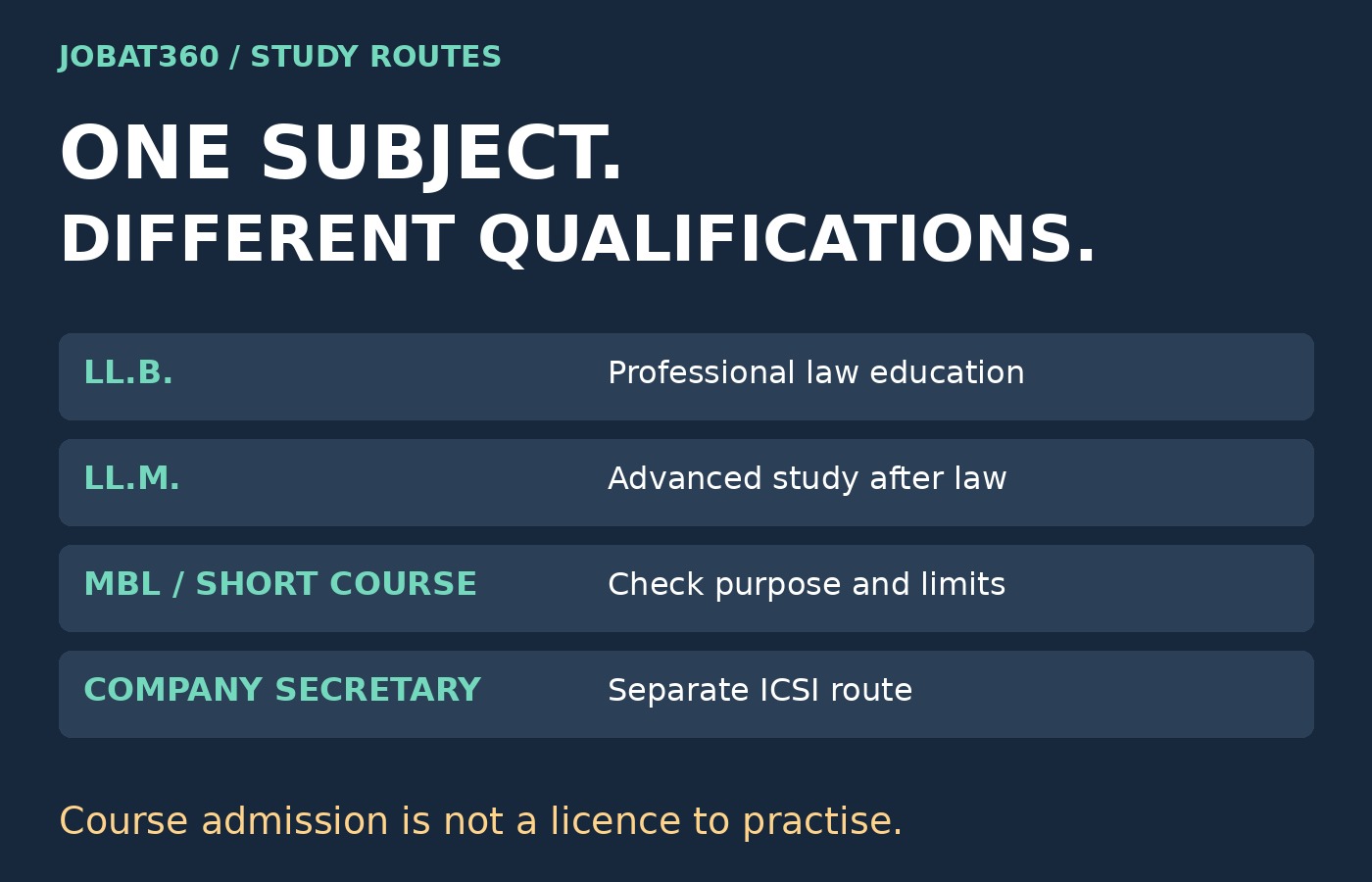
Before choosing a corporate-law course, decide what you need it to do. Learning to read a business contract, qualifying for an LL.M., pursuing the company-secretary profession and preparing for admission to legal practice are different goals. A course title containing “corporate law” does not make those routes interchangeable.
This guide separates the routes using official university and professional-body information. It is a way to build a shortlist, not an admission offer, legal opinion or promise of employment. Check the current programme notice and applicable professional rules before paying.
Start with the destination, not the certificate
Write one sentence describing your goal. For example: “I want a professional law degree after my commerce degree,” or “I manage procurement and want to understand contract risks.” Those statements point to different kinds of education.
- Professional law education: investigate a qualifying LL.B. route and the separate requirements for enrolment and practice.
- Advanced legal study: investigate an LL.M. if you have the required prior legal qualification.
- Business-law knowledge: investigate a suitable continuing-education degree, diploma or certificate, checking its audience and limits.
- The company-secretary profession: investigate ICSI’s own registration, examination and training requirements.
A useful subject can be taught across several routes. That does not mean the awards confer the same rights, have the same prerequisites or satisfy the same employer requirements.
After Class 12: examine the integrated law-degree route
The Bar Council of India’s educational-qualification clarification distinguishes five-year law courses from three-year law courses. It describes the school-qualification sequence for the integrated route and a graduation-based sequence for the three-year route. It also makes clear that meeting minimum qualifying marks does not automatically secure admission: other notified institutional criteria still apply.
For a school student seeking professional law education, an integrated law degree is therefore a different decision from a short corporate-law course. Read the institution’s exact degree name, recognition, qualifying-exam requirements, selection process, attendance rules and curriculum. Do not assume that one entrance test admits students to every law school.
Do not choose only by a “corporate” label. A broad legal foundation matters. Compare legal methods, contracts, constitutional law, procedure, ethics, research and writing, alongside company-law teaching and electives. Ask what practical work and feedback students actually receive.
After a non-law degree: an LL.B. and an LL.M. are not substitutes
NLSIU’s official three-year LL.B. (Hons.) page describes a professional programme open to graduates from different disciplines and a qualifying degree for admission to legal practice. Its LL.M. page, by contrast, requires an LL.B. degree or equivalent examination. These examples show why “postgraduate law course” is not a sufficient eligibility check.
A commerce or engineering graduate should not assume that an LL.M. is the next available step simply because a directory groups it under courses after graduation. Check the prior-degree requirement on the university’s own page. If the objective is professional law education, investigate the appropriate qualifying route rather than trying to replace it with a shorter award.
Time commitment also needs checking. NLSIU describes its three-year LL.B. as full-time, with compulsory attendance and internships. Its FAQ says students cannot maintain full-time or part-time employment alongside that programme. This is a programme-specific example, not a rule asserted here for every institution.
Already have a law degree? Compare the actual LL.M. content
An advanced degree should answer a more specific question than “will another qualification help?” You might want deeper study of commercial transactions, governance, financial systems or dispute resolution. Compare the core course, electives, dissertation, teaching approach and available academic support.
NLSIU’s LL.M. page lists Commercial Laws among its concentrations, alongside a general stream and other concentrations. It also warns that precise electives vary and are announced before the relevant term. A broad field description is not a guarantee that one particular mergers-and-acquisitions elective will run in your year.
Read what appears on the degree and transcript. The same page explains that it issues a uniform master’s degree certificate while the chosen concentration appears on transcripts. Do not turn a marketing description into an invented formal award title.
Business-law study for managers is a separate option
NLSIU PACE’s Master of Business Laws provides a concrete example of a different audience and purpose. Its page describes a two-year hybrid programme covering subjects including contracts, banking, corporate law, investment, intellectual property and taxation. Its minimum entry requirement is a recognised graduate degree in law or another field.
The page distinguishes MBL from LL.B. and LL.M. It also states that MBL graduates cannot appear in courts on the strength of that qualification. That is an important boundary for a non-law graduate comparing business-law education with the professional-law route.
This example is not a recommendation that every reader should take MBL. At the time of checking, the page’s admission-status box was marked closed, while an older paragraph still referred to admissions being open with an August 2026 deadline. Do not treat that old paragraph as an invitation to apply now. Use the current admissions notice or obtain written clarification for the next intake.
Company secretary: use ICSI’s own route
ICSI’s prospective-student page separates CSEET registration, Executive registration for CSEET-pass students and direct Executive registration. Its training page lists training guidelines, development programmes, long-term training, exemptions and training clearance.
The practical lesson is simple: a generic corporate-law certificate does not establish completion of the company-secretary professional route. Check which ICSI entry category applies to you, what examinations and training remain, and the current rules for the cohort in which you would register. Do not infer a direct-entry exemption or training exemption from a course advertisement.
Studying company law can be relevant to both law and governance work. Shared subject matter does not make a CS qualification and an LL.B. identical, or automatically substitute one for the other.
Recognition, enrolment and practice need their own check
Admission to a course, earning an academic award, enrolment on a State Bar Council roll and meeting applicable practice requirements are separate questions. NLSIU’s professional-law page discusses State Bar Council enrolment and the All India Bar Examination. Do not describe the process simply as registering a short certificate with the BCI.
The BCI’s AIBE-XIX instructions also emphasise recognised institutions and set out specific categories of candidates who could register, including certain final-semester students and graduates without enrolment. That is a historical exam-specific notice, not this guide’s statement of eligibility for a later examination. It illustrates why the sequence and documentation must be checked against the relevant current notification.
Before committing to a course for a professional purpose, verify the institution and exact programme with the appropriate official body. If employment status, qualification mode or another personal circumstance affects your route, obtain current official guidance. This article does not certify an individual reader’s right to practise.
What a useful corporate-law syllabus should let you do
Use the published syllabus to identify topics, then examine how learning is assessed. The NLSIU examples include contract law, corporate law, investment law, research and practical components, but different programmes package them differently.
A practical comparison can ask whether you will practise identifying an issue, locating the relevant authority, explaining uncertainty and writing for a business audience. A recorded lecture and an assessed drafting exercise with individual feedback are different learning experiences. Ask for a sample assignment and assessment rubric rather than assuming that every course includes supervised drafting.
For a small self-directed exercise, use a fictional supplier agreement. List the parties, commercial objective, payment obligations, termination provisions and questions needing further review. Produce a one-page issue note, clearly labelled as a learning exercise rather than advice. Do not copy an employer’s confidential contract into a public portfolio or submit someone else’s work as your own.
Check the full commitment before paying
- Exact award and issuer: distinguish the university or professional body awarding it from a teaching partner or marketing platform.
- Entry criteria: verify the qualification, category and selection rules for the actual intake, not a general percentage from an old list.
- Teaching and assessment: check live versus recorded sessions, feedback, examinations, attendance and any travel requirement.
- Total cost: obtain current tuition and other mandatory charges, payment dates, repeat-exam costs and refund or withdrawal conditions.
- Outcome evidence: ask what placement support means. Access to a job board, an interview and an employment offer are not the same result.
Evaluate job requirements separately. A course may improve subject knowledge without satisfying a role’s formal qualification or experience requirement. This guide does not reproduce salary ranges, rank providers or promise that a particular certificate will secure an in-house counsel, compliance or law-firm role.
Questions worth settling first
Can a certificate make me a corporate lawyer? Do not treat a short certificate as a substitute for a qualifying law degree and applicable professional requirements. Check the route for your intended work.
Can a non-law graduate study business law? Some programmes accept such graduates, as the MBL example shows. That does not establish eligibility for every programme, or make that award equivalent to LL.B.
Is an LL.M. the first step after any bachelor’s degree? No. The official NLSIU LL.M. example requires a prior law qualification. Read the exact institution’s rules.
Which course is best? Start with the function you need the qualification to perform. Then compare eligibility, recognition, curriculum, assessment, schedule and cost. A shorter course is not a saving if it cannot meet the goal you bought it for.
Sources and limits, checked 28 November 2026
- Chegg India: Corporate Law Courses, full topic and FAQs read. This original guide does not adopt its provider fee tables, broad eligibility claims, salary estimates or career guarantees.
- BCI: Educational Criteria and Educational Qualification, clarification distinguishing three- and five-year entry routes and the limits of minimum qualifying marks.
- NLSIU: three-year LL.B. (Hons.), professional-degree purpose, curriculum, attendance, work-commitment FAQ and distinction from LL.M. No admission dates or fee figures are reproduced here.
- NLSIU: LL.M., prior law qualification, concentrations, degree/transcript distinction and variable electives.
- NLSIU PACE: Master of Business Laws, graduate entry, two-year programme, syllabus, award distinctions and closed admission status. Older open-admissions wording on the same page is not relied upon.
- ICSI: Prospective Students and ICSI: Training, separate registration pathways and training framework. Individual exemptions and current cohort requirements require their own check.
- BCI: AIBE-XIX registration instructions, recognition and exam-specific candidate categories, cited as a historical example, not current exam advice.
Jobat360 is an independent information publisher, not a law school, professional regulator or recruitment agency. This article is educational information, not legal or admissions advice. No admission, professional eligibility, job or salary is guaranteed.
Disclosure: For information and education only, not investment advice. We are not a SEBI-registered analyst. Double-check original sources before financial decisions. We hold zero shares in companies mentioned in this article. We do not take or promote positions on misleading price information for personal gain, or use this platform to mislead traders or investors. Our purpose is financial literacy and access to information, without a personal or monetary motive behind the information shared.
FOLLOW WOLF OF INDIA, FREE EVERYWHERE
WEBSITES
Wolf of Dalal Street: https://wolfofdalalstreet.com
Stockmarket360: https://stockmarket360.in
BizTechIndia: https://biztechindia.com
Jobat360: https://jobat360.com
Trending on Net: https://trendingonnet.com
Blog + daily digest: https://wolfofdalalstreetofficial.blogspot.com and https://wolfofindia.blogspot.com
APP
Free news app: https://wolfnews.surge.sh (turn on notifications)
YOUTUBE
Wolf of Dalal Street: https://www.youtube.com/@WOLFOFINDIA360
CHANNELS (free updates by message, our newsletter)
WhatsApp channel: https://whatsapp.com/channel/0029VaswZ107YSdBnLu1FY3g
Telegram (Wolf of India): https://t.me/WOLFOFINDIA
Telegram (Wolf of Dalal Street): https://t.me/wolfofdalalstreetofficial
Telegram (Stockmarket360): https://t.me/stockmarket360official
Telegram (BizTechIndia): https://t.me/biztechindia
Telegram (Trending Online): https://t.me/Trendingonlineofficial
WhatsApp Business (join, message preferred): https://wa.me/919619991645
PROFILES
LinkedIn: https://www.linkedin.com/company/wolfofdalalstreet/
Instagram: https://www.instagram.com/wolfofindiaofficial
Facebook: https://facebook.com/wolfofdalalstreetofficial
X: https://x.com/Wolf_India360
Reddit community: https://www.reddit.com/r/WOLFOFDALALSTREETJOIN/
Quora Space: https://wolfofdalalstreet.quora.com
Diigo: https://www.diigo.com/user/wolfdalalstreet
RSS FEEDS
https://wolfofdalalstreet.com/feed/ | https://stockmarket360.in/feed/ | https://biztechindia.com/feed/ | https://jobat360.com/feed/ | https://trendingonnet.com/feed/ | https://wolfofdalalstreetofficial.blogspot.com/feeds/posts/default
Market and business education only. Not investment advice. No tips, no targets.