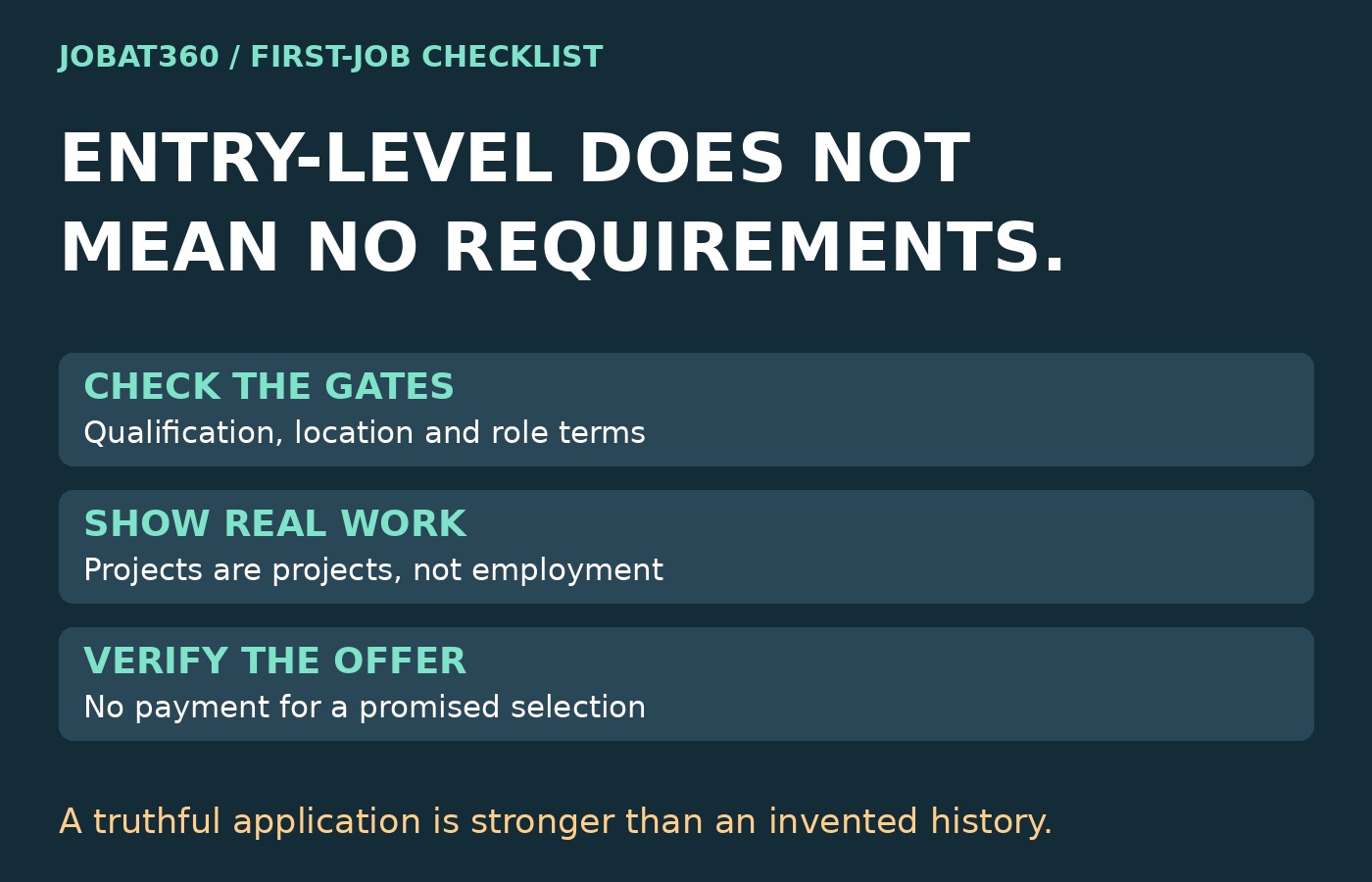
An entry-level label is a starting point for reading a vacancy, not proof that anyone can apply. A role can welcome beginners and still specify a qualification, graduation batch, language, location, shift pattern or practical skill. Your first task is to check those conditions. Your next is to show what you can actually do.
This guide explains how to assess an entry-level opportunity and prepare an honest application. It is not a list of current vacancies or a salary forecast. Employer programmes below are examples of requirements and process, not recommendations to apply without checking their current status.
What entry-level should mean for your search
Entry-level usually describes work near the beginning of a career in a field. It does not have one universal definition across employers. Search terms such as junior, associate, trainee, graduate and assistant can help find leads, but the responsibilities and eligibility matter more than the title.
Do not assume that a job is easy, low-pressure or fully remote because it is described as suitable for freshers. Read the workload, targets, hours, reporting arrangements and location. Equally, do not assume that every beginner role is a software job: customer operations, administration, accounts support, sales and content work can involve different starting tasks and requirements.
Choose a task family rather than collecting unrelated titles. If you enjoy checking records, look closely at the actual data or operations work. If you want customer support, check communication, language, product and shift requirements. These are ways to organise a search, not claims that a particular vacancy is open.
Separate eligibility from skills you can build
Make two lists when reading a vacancy. The first contains stated gates: qualification, completion date, marks where required, permitted location, work authorisation, experience limits and application deadline. The second contains skills and evidence you can develop or describe more clearly.
Do not silently convert a mandatory condition into a preference. If wording is unclear, seek clarification through the employer’s official route. If a role says a skill is preferred, explain your relevant strengths without pretending the preference does not exist. Never change your graduation year or invent employment to make a form accept you.
A useful historical example is TCS’s B.Sc Ignite Hiring page for the 2026 batch. It describes the requirement as entry-level but still lists courses, batch and other conditions, and asks candidates to declare prior experience if any. At the time checked, registration was marked closed. It is evidence that entry-level does not mean unrestricted eligibility, not an open-job alert.
A practical vacancy check
For each lead, record the employer’s official page, exact title, job or notice identifier if available, location, employment type, deadline and date you checked it. A screenshot shared in a group is a lead to verify, not the final application authority.
- Is the opening still active? Read the current application status, not only the page’s continued existence.
- Do you meet the stated gates? Compare your actual qualification and circumstances with the notice.
- What work will you do? Identify the first tasks, not just a broad department name.
- What is the arrangement? Distinguish employee, fixed-term worker, intern, apprentice and independent contractor.
- What is the application route? Follow the employer’s instructions and confirm the submission state.
A programme overview can stay online between intakes. Microsoft’s early-career page describes several internship and rotation programmes with different audiences. For example, its university-internship description refers to current students, while its Discovery description has a particular educational stage and US locations. A global programme page is not proof of an India opening or of your individual eligibility.
Replace vague claims with small, inspectable evidence
Without previous employment, you can still describe genuine coursework, personal projects, volunteering or other relevant activities. Label each accurately. A practice spreadsheet is a self-directed project, not a job at a company. Group work should identify your contribution rather than implying that you completed everything alone.
Use this fictional worksheet to plan evidence. These are suggested learning exercises, not published employer requirements:
- Records or operations: clean a small synthetic dataset, preserve the original, document duplicate-handling decisions and explain checks.
- Customer support: write sample replies to fictional enquiries, explain when you would escalate and avoid promising refunds you cannot authorise.
- Software or testing: build a small feature or test plan, show how to run it and document a failure you found.
- Writing: prepare a short original explainer with source links and explain how you checked its claims.
The point is not to accumulate large projects. It is to let someone inspect the work and understand your reasoning. Use public or synthetic data. Do not publish customer information, a previous employer’s files or work you are not allowed to share.
Write the resume around relevance, not invented experience
The NCS CV builder provides sections for education, languages, skills and work experience. Use fields that fit your real history. A template’s work-experience box is not an instruction to manufacture a job.
For a genuine project, a useful description names the task, your action, the output and a limitation. For example: “Self-directed spreadsheet exercise: checked a synthetic order file for duplicate IDs, documented exceptions and prepared a summary. Not a live customer dataset.” Add a measured result only when you recorded it and can explain how you obtained it.
Keep dates, qualifications and names consistent across the resume and application. Follow the actual upload instructions. A general CV tool may suggest a photo or social links, while an employer can prohibit them. The closed TCS example, for instance, asks candidates not to include a photo or hyperlinks in the CV. That historical instruction is not a universal resume rule; it demonstrates why the specific notice wins over a generic template.
Prepare for the assessment the employer describes
Microsoft’s early-career interview guidance says its process varies by role and may ask candidates to code, share a portfolio or project, or provide other work examples. It describes checking base knowledge, critical thinking, problem-solving and the ability to learn. Those are Microsoft’s stated practices, not a promise about every employer’s interview.
For your own preparation, practise explaining one piece of work from beginning to end. What was the problem? What did you try? What did you check? What failed? What would you improve? Be clear about where you used a tutorial or another person’s help.
When you do not know an answer, state the gap and explain how you would investigate it. Do not claim a tool proficiency that you cannot demonstrate. Check the employer’s rules on assistance and tools during tests rather than assuming outside help is permitted.
Internship, apprenticeship and employment are different offers
An internship is not automatically a permanent job. An apprenticeship should be assessed as its own training arrangement. The NATS official overview describes on-the-job training and expressly states that employment is not guaranteed after completion of apprenticeship.
Read the individual notice and agreement for eligibility, duration, training, stipend, attendance, location, completion conditions and any obligations. Do not treat an indicative scheme description as the final terms of every placement. A claim of likely conversion is not a written offer of future employment.
The same care applies to contractor or freelance work advertised to beginners. Ask who pays you, for what output, when payment is due and what costs you bear. The word “entry-level” does not answer those questions.
Do not pay to unlock a promised job
NCS states that it charges no fee at registration, job application or interview processing and advises jobseekers not to pay fees to employers. It warns about people falsely claiming an association with NCS. Use the official NCS site to verify its communications.
TCS’s recruitment-fraud alert says it does not ask candidates for payment or a security deposit during recruitment. It also warns that fraudulent vacancies can appear on otherwise reputable job portals and that impostors may use real employees’ names. A familiar logo, a verified platform or a plausible reference is not enough to validate an offer.
Pause when someone requests a deposit, asks for payment to guarantee selection or pressures you to send sensitive information through an unverified route. Locate the employer’s official careers or fraud-reporting page independently. An apparently company-like address is not proof by itself. Never share an OTP, account password or payment PIN to obtain a job.
Track the application, not just the number submitted
Keep a simple record of the vacancy, source link, eligibility check, resume version, submission confirmation and next stated step. Distinguish creating an account from applying for the actual role. In the closed TCS example, the instructions distinguish registration from applying for the drive and describe an application-received status.
Review your search by failure point. If your leads mostly fail eligibility checks, change the search filters. If you cannot show relevant work, build a focused sample. If tests expose a repeated gap, practise that skill. If interviews are not progressing, review your explanations and the role fit. None of these patterns alone proves why a particular employer declined an application.
Bottom line: the useful beginner application is specific and truthful. Check that the opening is real and active, check that its conditions fit, show relevant evidence and retain proof of what you submitted. Entry-level is a description of the role, not a guarantee of selection.
Sources and scope, checked 28 November 2026
- Chegg India: Entry Level Jobs, full article and FAQs read. This original guide does not repeat its salary ranges, demand forecasts, current-hiring claims or low-pressure-work assumptions.
- National Career Service, service scope, no-fee statement and fake-communication warning.
- NCS CV builder, sections available for education, languages, skills and experience; not a universal employer formatting standard.
- Microsoft: early-career interviewing tips, role-dependent assessments and work examples.
- Microsoft: early-career programmes, different programme audiences, not a verified list of India vacancies.
- TCS B.Sc Ignite Hiring, batch of 2026, expressly closed historical example of eligibility, CV instructions and application status. Not an invitation to apply now.
- TCS recruitment-fraud alert, no-payment policy and impersonation warnings.
- NATS: scheme overview, on-the-job training and no guarantee of employment afterward. Individual placement terms require their own check.
Jobat360 is an independent information publisher, not the employer, a recruitment agency or an application portal. No vacancy, eligibility decision, interview, job, salary or apprenticeship conversion is guaranteed.
Disclosure: For information and education only, not investment advice. We are not a SEBI-registered analyst. Double-check original sources before financial decisions. We hold zero shares in companies mentioned in this article. We do not take or promote positions on misleading price information for personal gain, or use this platform to mislead traders or investors. Our purpose is financial literacy and access to information, without a personal or monetary motive behind the information shared.
FOLLOW WOLF OF INDIA, FREE EVERYWHERE
WEBSITES
Wolf of Dalal Street: https://wolfofdalalstreet.com
Stockmarket360: https://stockmarket360.in
BizTechIndia: https://biztechindia.com
Jobat360: https://jobat360.com
Trending on Net: https://trendingonnet.com
Blog + daily digest: https://wolfofdalalstreetofficial.blogspot.com and https://wolfofindia.blogspot.com
APP
Free news app: https://wolfnews.surge.sh (turn on notifications)
YOUTUBE
Wolf of Dalal Street: https://www.youtube.com/@WOLFOFINDIA360
CHANNELS (free updates by message, our newsletter)
WhatsApp channel: https://whatsapp.com/channel/0029VaswZ107YSdBnLu1FY3g
Telegram (Wolf of India): https://t.me/WOLFOFINDIA
Telegram (Wolf of Dalal Street): https://t.me/wolfofdalalstreetofficial
Telegram (Stockmarket360): https://t.me/stockmarket360official
Telegram (BizTechIndia): https://t.me/biztechindia
Telegram (Trending Online): https://t.me/Trendingonlineofficial
WhatsApp Business (join, message preferred): https://wa.me/919619991645
PROFILES
LinkedIn: https://www.linkedin.com/company/wolfofdalalstreet/
Instagram: https://www.instagram.com/wolfofindiaofficial
Facebook: https://facebook.com/wolfofdalalstreetofficial
X: https://x.com/Wolf_India360
Reddit community: https://www.reddit.com/r/WOLFOFDALALSTREETJOIN/
Quora Space: https://wolfofdalalstreet.quora.com
Diigo: https://www.diigo.com/user/wolfdalalstreet
RSS FEEDS
https://wolfofdalalstreet.com/feed/ | https://stockmarket360.in/feed/ | https://biztechindia.com/feed/ | https://jobat360.com/feed/ | https://trendingonnet.com/feed/ | https://wolfofdalalstreetofficial.blogspot.com/feeds/posts/default
Market and business education only. Not investment advice. No tips, no targets.