A cost sheet is useful only when it answers the right question. The cost of serving one more customer, the cost assigned to an existing product and the cash saved by cancelling it can be different numbers. Treating them as interchangeable can turn tidy arithmetic into a poor decision.
This Jobat360 learning guide explains cost accounting through a fictional stationery workshop. It is for students and early-career learners, not a substitute for professional accounting, tax or compliance advice. All workshop amounts are invented teaching inputs, not market prices or a business forecast.
Start with the object, period and decision
Before opening a spreadsheet, finish this sentence: “I need the cost of ___, for ___, to decide ___.” The blank might be one notebook, a print order, a department or a month of operations. That choice is the cost object. Without it, even the label “direct cost” is incomplete: a supervisor’s salary may be traceable to a department but not economically traceable to each notebook.
Cost accounting measures and explains resource use. Managers can use the resulting information for planning, pricing, control and decisions. It does not mechanically set a selling price or create demand. A beautifully documented cost still needs to be compared with what customers will buy and what the business can deliver.
Use two classifications, not four separate boxes
Direct versus indirect asks whether an expense can be traced to the chosen object economically. Fixed versus variable asks how the expense behaves as activity changes over a stated period and operating range. These are different questions. A cost can have one label from each pair.
- Paper used for an order can be direct and variable.
- A monthly salary dedicated to one project can be direct to that project and fixed over the month.
- Small shared production supplies can be indirect to individual units while varying with output.
- A shared workshop lease can be indirect to each notebook and fixed within the current space and contract.
Mixed costs contain both parts. A utility bill may have a standing charge plus usage charges. Do not classify the entire bill as variable simply because it rose last month. Likewise, fixed does not mean fixed forever. Adding another production space or shift can change the cost structure. OpenStax and ACCA both explain why activity range and the actual payment arrangement matter.
A worked example: contribution is not final profit
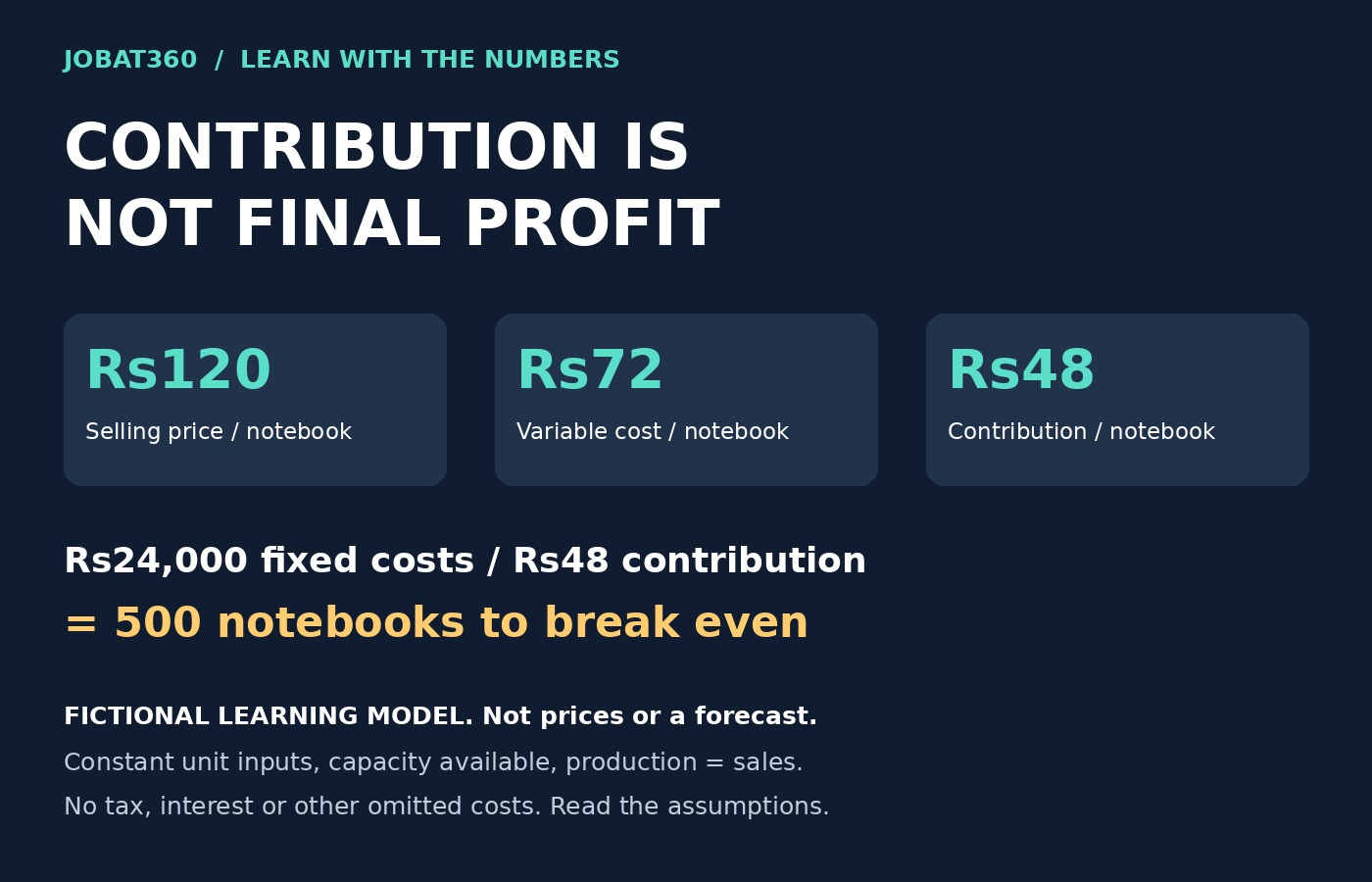
Assume the fictional workshop sells one kind of notebook for Rs120. Variable cost is Rs72 per notebook sold. Monthly fixed operating costs are Rs24,000. Assume production equals sales, no inventory movement, no tax, interest or other omitted costs, constant unit prices and sufficient capacity within the volumes below.
- Contribution per notebook: Rs120 minus Rs72 = Rs48.
- Operating break-even: Rs24,000 divided by Rs48 = 500 notebooks.
- At 650 notebooks: revenue is Rs78,000; variable cost is Rs46,800; contribution is Rs31,200.
- After the assumed fixed costs, modelled operating profit is Rs7,200.
The Rs48 is available to cover fixed costs and then profit. It is not Rs48 of take-home earnings on every sale. At 400 notebooks, contribution is Rs19,200 and the same simplified model shows a Rs4,800 operating loss. At 500, it shows neither profit nor loss.
At planned sales of 650, the margin of safety is 150 notebooks, about 23.1% of planned volume. That is a modelled buffer, not a prediction that demand is safe. Returns, discounts, spoilage, delivery charges or stepped-up fixed costs can change the answer.
Change one assumption and explain the result
If variable cost rises to Rs80 while price and fixed costs stay unchanged, contribution falls to Rs40. Break-even becomes 600 notebooks. At 650 sales the modelled operating profit is now Rs2,000, not Rs7,200. A small input change can matter more than an impressive-looking sales total.
For a target operating profit of Rs12,000 under the original assumptions, required contribution is Rs36,000. Divide by Rs48 to get 750 notebooks. This calculation does not establish that 750 customers exist or that capacity is available. ACCA’s cost-volume-profit guidance makes clear that constant prices, cost behaviour and, for multiple products, sales mix are limiting assumptions.
Choose a costing method that matches the work
Job costing follows identifiable custom work, such as a separately specified print order. A job sheet can collect materials issued, recorded labour and an explained overhead charge. Process costing pools costs through repeated production processes and assigns average costs to output. OpenStax treats the production process and ability to trace costs as central to that choice.
Absorption costing includes an allocation of fixed production overhead in product cost. The allocation basis must be stated. A rate based on machine hours is a method of assigning cost, not proof that every rupee disappears if one product stops.
Activity-based costing separates overhead into activity pools, selects drivers, calculates a rate for each driver and assigns costs according to activity used. For example, a fictional Rs12,000 setup-cost pool divided by 20 setups gives Rs600 per setup. An order requiring three setups would receive Rs1,800 from that pool. This does not include its paper, labour or other overhead. ABC needs credible activity data; extra detail cannot repair an arbitrary driver.
Standard costing compares planned standards with actual results. A difference is a prompt to investigate price, usage, output or other causes, not automatic evidence that an employee performed badly. Keep the standard’s date and assumptions visible.
For a new decision, ask what actually changes
A customer offers a fictional one-off order of 100 notebooks at Rs95 each. Under the original Rs72 variable cost, additional revenue is Rs9,500 and variable cost is Rs7,200. Suppose the order also requires an avoidable setup payment of Rs1,000. Its incremental surplus is Rs1,300 before any other changed cash flows.
That is a starting analysis, not an instruction to accept. Check capacity, displaced regular orders, payment risk, quality requirements and future pricing effects. An unchanged allocation of existing rent is not an extra cash payment caused by this order. But new rental space needed for it would be relevant. A past design expense that cannot be recovered is sunk; an alternative use of scarce capacity can create an opportunity cost.
ACCA’s relevant-cost guidance separates changed future cash flows from sunk costs and unchanged allocations. Do not use that distinction to erase real long-run overhead or ignore commitments. Short-run order analysis and sustainable pricing answer different questions.
A small portfolio task that demonstrates understanding
- Create an assumptions tab with units, period, capacity and every fictional input clearly labelled.
- Build a cost register recording amount, evidence, object, traceability, behaviour and allocation basis.
- Show contribution, break-even and operating result at 400, 500 and 650 notebooks.
- Add the Rs80 variable-cost scenario without overwriting the original case.
- Write a short decision note explaining what the model excludes and what evidence would change the conclusion.
Reconcile the totals before adding charts. Separate inputs from formulas, flag missing records and retain a change log. This exercise can demonstrate your reasoning, but it is not a professional qualification, licence or promise of employment.
Keep statutory claims separate from a learning model
Do not assume internal costing is entirely unstandardised. The Institute of Cost Accountants of India publishes Cost Accounting Standards covering subjects including classification, capacity, overheads, materials and inventory valuation. Which legal or reporting requirements apply to a real organisation needs a separate check. This article does not determine applicability, prescribe an inventory valuation method or claim that a sample spreadsheet meets any statutory obligation.
Bottom line: name the decision first, classify costs on the right axes, show your assumptions and explain the costs that change. An honest model with stated limits is more useful than a precise-looking answer to the wrong question.
Sources and scope, checked 27 November 2026
- Chegg India: Cost Accounting: The Essential Strategy for Profits (2025), source topic reviewed in full. This article uses an independent structure and new fictional examples; it does not repeat earnings or career-demand promises.
- ACCA: Cost-volume-profit analysis, contribution, break-even, target profit, margin of safety and model limitations.
- ACCA: Relevant costs, changed future cash flows, sunk costs and opportunity costs.
- ACCA: Activity-based costing, overhead allocation and activity drivers.
- OpenStax: Basic cost behaviour patterns, cost classifications and operating ranges.
- OpenStax: Job order and process costing, method selection. These are educational concepts, not an assertion about Indian statutory reporting.
- ICMAI: Cost Accounting Standards downloads, evidence that formal standards exist; applicability to an individual organisation is not assessed here.
Jobat360 is an independent information publisher, not an accounting firm, qualification provider or placement agency. No business profit, admission or job outcome is guaranteed.
Disclosure: For information and education only, not investment advice. We are not a SEBI-registered analyst. Double-check original sources before financial decisions. We hold zero shares in companies mentioned in this article. We do not take or promote positions on misleading price information for personal gain, or use this platform to mislead traders or investors. Our purpose is financial literacy and access to information, without a personal or monetary motive behind the information shared.
FOLLOW WOLF OF INDIA, FREE EVERYWHERE
WEBSITES
Wolf of Dalal Street: https://wolfofdalalstreet.com
Stockmarket360: https://stockmarket360.in
BizTechIndia: https://biztechindia.com
Jobat360: https://jobat360.com
Trending on Net: https://trendingonnet.com
Blog + daily digest: https://wolfofdalalstreetofficial.blogspot.com and https://wolfofindia.blogspot.com
APP
Free news app: https://wolfnews.surge.sh (turn on notifications)
YOUTUBE
Wolf of Dalal Street: https://www.youtube.com/@WOLFOFINDIA360
CHANNELS (free updates by message, our newsletter)
WhatsApp channel: https://whatsapp.com/channel/0029VaswZ107YSdBnLu1FY3g
Telegram (Wolf of India): https://t.me/WOLFOFINDIA
Telegram (Wolf of Dalal Street): https://t.me/wolfofdalalstreetofficial
Telegram (Stockmarket360): https://t.me/stockmarket360official
Telegram (BizTechIndia): https://t.me/biztechindia
Telegram (Trending Online): https://t.me/Trendingonlineofficial
WhatsApp Business (join, message preferred): https://wa.me/919619991645
PROFILES
LinkedIn: https://www.linkedin.com/company/wolfofdalalstreet/
Instagram: https://www.instagram.com/wolfofindiaofficial
Facebook: https://facebook.com/wolfofdalalstreetofficial
X: https://x.com/Wolf_India360
Reddit community: https://www.reddit.com/r/WOLFOFDALALSTREETJOIN/
Quora Space: https://wolfofdalalstreet.quora.com
Diigo: https://www.diigo.com/user/wolfdalalstreet
RSS FEEDS
https://wolfofdalalstreet.com/feed/ | https://stockmarket360.in/feed/ | https://biztechindia.com/feed/ | https://jobat360.com/feed/ | https://trendingonnet.com/feed/ | https://wolfofdalalstreetofficial.blogspot.com/feeds/posts/default
Market and business education only. Not investment advice. No tips, no targets.