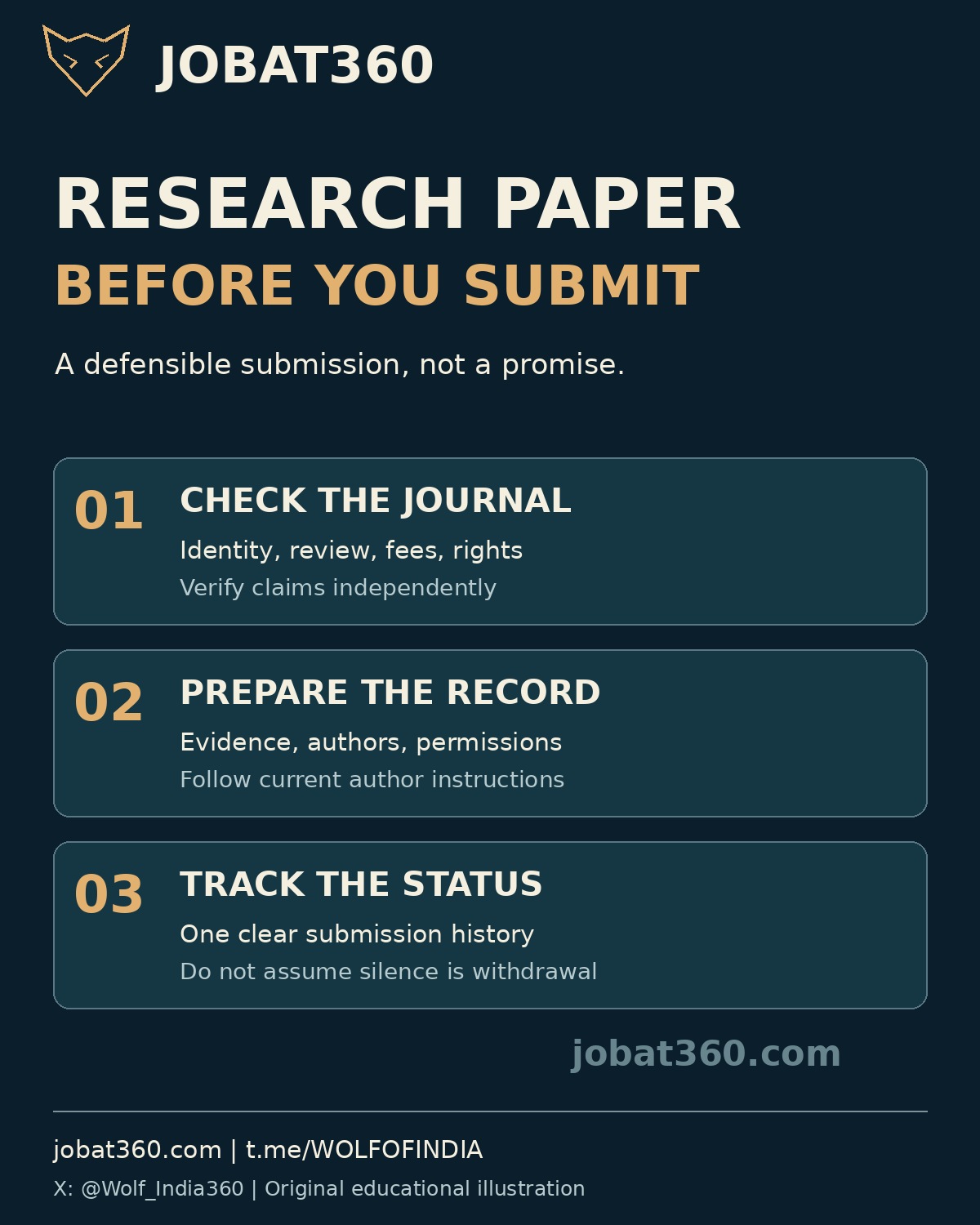
Before uploading a research paper, make sure you can explain two things: why the work is ready to share and why this journal is an appropriate place for it. A promise of fast acceptance answers neither question.
For a first-time author, the useful goal is a defensible submission, not a guaranteed publication. This guide offers an original preparation worksheet, grounded in journal-assessment and publication-ethics guidance. It does not endorse a journal, sell publication or confirm institutional credit.
Separate the research question from the publication target
Write a short account of the question, the method, the evidence and the limits of the result. Check that each conclusion is supported by what was actually done. A manuscript with attractive formatting can still overstate its findings.
Ask an appropriate supervisor or collaborator to review the work and the requirements that apply to it. If the project involves people, animals, sensitive information or other regulated activity, establish the relevant institutional and ethics requirements before doing the work. Do not invent an approval number or assume a later journal submission fixes a missing permission.
Assess the journal through evidence, not its invitation
Think. Check. Submit.’s journal checklist asks authors to examine publisher identity, contact details, peer review, indexing and archiving, fees, licences and author guidance. It also asks whether authors know the journal and can find its recent papers.
Use the journal’s own website as a starting point, then independently check claims with the named service or organisation. A logo or indexing claim on a publisher page is a claim to verify. A familiar-sounding title may belong to a different publication.
Read recent papers to judge whether the subject, article type and intended readers fit your work. A metric alone does not settle that question. This article makes no current indexing, ranking or recognition claim about any particular journal.
Keep a journal-check record
For each candidate, note the exact title, publisher, website and date checked. Then collect answers to these questions:
- Scope: Does the journal consider this subject and article type?
- Review: Does it clearly describe how review works, rather than promise acceptance?
- Costs: What may be charged, in which currency, at which stage, and under what waiver or refund rules?
- Rights: What licence or copyright agreement applies, and which version may you share?
- Preservation: What indexing and long-term archiving are claimed, and where did you verify them?
- Requirements: What does your institution, funder or supervisor require for this specific purpose?
This is a preparation aid, not a pass certificate. If a material answer remains unclear, ask the publisher or an institutional librarian before committing. A disclosed fee does not by itself prove either legitimacy or fraud. A promise of guaranteed acceptance or implausibly rapid review calls for closer checking.
Prepare a submission package for that journal
Use its current author instructions, not a generic formatting rule found elsewhere. Record the article type, word limit, required files, figure specifications, reference style, declarations and submission route. Requirements can differ across journals and across article types.
Check names, affiliations and author order with the people involved. Resolve contributions, corresponding-author responsibilities and approval of the submitted version before upload. Where the journal asks about funding, conflicts, data availability, ethics or AI-assisted work, provide accurate disclosures under the applicable policy. Do not treat a generated citation or a plagiarism score as proof of originality.
Open every reference you rely on and confirm that it supports the sentence attached to it. Check figure permissions and data-sharing limits. Never upload private participant information or someone else’s unpublished manuscript to a service without appropriate permission.
One manuscript needs a clear submission status
COPE’s position on concurrent and duplicate submissions says submitting the same paper to multiple journals at once, or recycling an already published paper for another journal, is problematic publication practice. Its guidance notes that some journals reject concurrent submissions automatically.
Keep a simple status log: journal, submission identifier, submitted version, date, decision and current status. Before moving the manuscript elsewhere, resolve its status with the first journal and keep the withdrawal confirmation or other relevant record. Do not assume silence means it is no longer under consideration.
If a preprint, conference version, thesis or related manuscript exists, check the target journal’s current policy and disclose it where required. Those categories are not interchangeable, and this guide does not decide whether a specific prior version is acceptable.
Respond to review without hiding the limits
Maintain a response document with one entry for each comment, the action taken and the location of the change. If you disagree, explain the reason and supporting evidence respectfully. Do not claim to have run an analysis or experiment you did not perform.
For example, in a fictional review, a referee asks for a longer follow-up period than the dataset contains. An honest response might explain the available period, narrow the conclusion and add a limitation. It would not invent additional observations. Whether the revision is sufficient remains the editor’s decision.
Keep versions clearly named so that the response letter, clean manuscript and marked-up manuscript agree. A revision request is not an acceptance guarantee. Follow the actual decision letter and deadline.
Do not confuse acceptance, payment and permission to share
Before paying anything, verify the invoice and publisher through independently reached official channels and confirm exactly what the charge covers. Do not pay a stranger for guaranteed acceptance or institutional recognition.
Read production proofs for errors in names, figures, references and substantive meaning. After publication, share only the version allowed by the relevant agreement and policy. An online copy, a preprint and the final journal version may have different sharing conditions.
For a career or academic application, verify the institution’s own current recognition requirements. A general publishing guide cannot promise that a paper will satisfy a degree, promotion, admission or funding rule.
A useful next step
Before clicking submit, assemble a one-page record linking the research question, evidence limits, author agreement, journal checks, required files and current submission status. Ask a suitable mentor or librarian to review unresolved points. The aim is a traceable, honest submission, not speed at any cost.
Sources checked 27 November 2026
- Chegg India: How to publish a research paper, topic source read in full. This original guide does not adopt its publication-success or paid-publishing claims.
- Think. Check. Submit.: Journals checklist, publisher-assessment guidance, including review, identity, fees, licences and archiving checks. The page states amendments in 2023.
- COPE: Handling concurrent and duplicate submissions, position reviewed 20 August 2024. Supports the submission-status and duplicate-submission cautions.
The worksheets and fictional reviewer example are original learning aids, not a journal’s rules. Jobat360 is an independent information publisher, not a journal, research-ethics committee or academic accreditor. Verify the current primary rules for your own work.
Disclosure: For information and education only, not investment advice. We are not a SEBI-registered analyst. Double-check original sources before financial decisions. We hold zero shares in companies mentioned in this article. We do not take or promote positions on misleading price information for personal gain, or use this platform to mislead traders or investors. Our purpose is financial literacy and access to information, without a personal or monetary motive behind the information shared.
FOLLOW WOLF OF INDIA, FREE EVERYWHERE
WEBSITES
Wolf of Dalal Street: https://wolfofdalalstreet.com
Stockmarket360: https://stockmarket360.in
BizTechIndia: https://biztechindia.com
Jobat360: https://jobat360.com
Trending on Net: https://trendingonnet.com
Blog + daily digest: https://wolfofdalalstreetofficial.blogspot.com and https://wolfofindia.blogspot.com
APP
Free news app: https://wolfnews.surge.sh (turn on notifications)
YOUTUBE
Wolf of Dalal Street: https://www.youtube.com/@WOLFOFINDIA360
CHANNELS (free updates by message, our newsletter)
WhatsApp channel: https://whatsapp.com/channel/0029VaswZ107YSdBnLu1FY3g
Telegram (Wolf of India): https://t.me/WOLFOFINDIA
Telegram (Wolf of Dalal Street): https://t.me/wolfofdalalstreetofficial
Telegram (Stockmarket360): https://t.me/stockmarket360official
Telegram (BizTechIndia): https://t.me/biztechindia
Telegram (Trending Online): https://t.me/Trendingonlineofficial
WhatsApp Business (join, message preferred): https://wa.me/919619991645
PROFILES
LinkedIn: https://www.linkedin.com/company/wolfofdalalstreet/
Instagram: https://www.instagram.com/wolfofindiaofficial
Facebook: https://facebook.com/wolfofdalalstreetofficial
X: https://x.com/Wolf_India360
Reddit community: https://www.reddit.com/r/WOLFOFDALALSTREETJOIN/
Quora Space: https://wolfofdalalstreet.quora.com
Diigo: https://www.diigo.com/user/wolfdalalstreet
RSS FEEDS
https://wolfofdalalstreet.com/feed/ | https://stockmarket360.in/feed/ | https://biztechindia.com/feed/ | https://jobat360.com/feed/ | https://trendingonnet.com/feed/ | https://wolfofdalalstreetofficial.blogspot.com/feeds/posts/default
Market and business education only. Not investment advice. No tips, no targets.