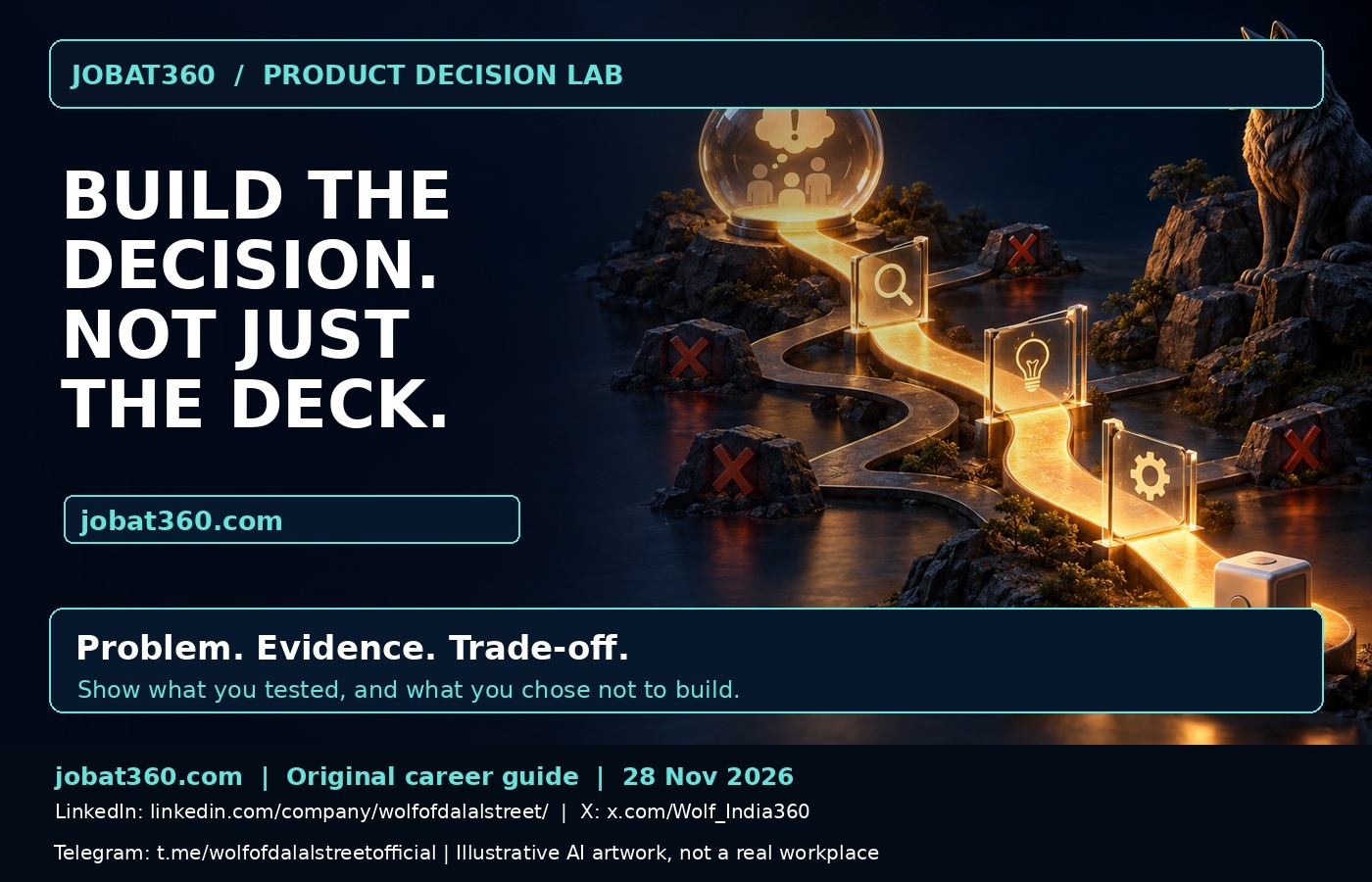
Career decision lab | 28 November 2026
A product-management portfolio should explain a decision, not merely display a redesigned app. What problem did you observe? Who had it? Which alternative did you reject? What evidence would make you change course? Those questions give a beginner something more useful to practise than copying a fashionable roadmap.
This original Jobat360 guide covers routes into product management, the skills to demonstrate and the limits of course and salary claims. It is career education, not a vacancy announcement or a placement promise. Employer requirements differ. Sources were checked on 28 November 2026.
Start with the work, not the title
Atlassian describes product managers as people who connect customer needs with business objectives, define direction and success, and help a team work toward it. Its account also warns against reading the familiar “CEO of the product” phrase as special authority over colleagues. Influence and an explainable trade-off matter more than a grand title.
Ask how a particular employer divides discovery, design, analytics, engineering, delivery and commercial work. In a small team one person may cover several activities. A larger team may have specialists. A job title alone does not establish the decisions you will own, the people you will manage or the tools you must already know.
Product manager, project manager and Product Owner are not interchangeable labels
A useful interview question is: “Which outcomes and decisions will this role own?” Follow it with questions about delivery coordination, backlog ordering, research and measurement. Avoid assuming that every product manager is also a people manager, project manager or Scrum Product Owner.
The official November 2020 Scrum Guide identifies a Product Owner accountability within Scrum. That person is accountable for maximising product value and effective Product Backlog management, including communicating the Product Goal, creating and communicating items, ordering them, and keeping the backlog understood. Work may be delegated; accountability remains. This is more specific than saying that a Product Owner just writes tickets.
Atlassian offers a practical product-manager/Product-Owner comparison, but also says responsibilities can shift with team practices. Use the Scrum Guide for what Scrum defines, and the employer’s description for how the actual job is organised. A certification name does not settle the boundaries of a job.
Choose an entry route you can support with evidence
If you are choosing education after Class 12
Do not treat a single marks threshold, degree or MBA as a universal entry rule for this occupation. Atlassian’s current role guide says there is no single required qualification and describes entrants from engineering, design, business and marketing. A college’s admission criteria and an employer’s recruitment criteria are separate checks.
Compare the institution, curriculum, assessment, practical work and total cost of any course you are considering. Look for opportunities to study research, data, commercial decisions and technology in context. Keep your educational choice broad enough to support other work you would genuinely consider. A product-management job immediately after a course is not guaranteed.
If you already work in another role
Use work you have permission to discuss. A support professional might explain a repeated customer problem. An analyst might show how a metric changed a decision. A designer or engineer might explain why a smaller test was chosen before a larger build. These are examples of evidence you could develop, not promises that those roles automatically convert into a product-management offer.
For an internal move, ask for a bounded contribution: synthesising existing feedback, clarifying an unresolved problem or helping evaluate a test. Agree on scope and credit. Do not publish confidential customer records, internal screenshots or business numbers in a personal portfolio without permission.
If you are applying as a fresher
Read the actual requirements for internships, associate roles and other entry positions rather than assuming “junior” means no experience. A clearly labelled independent case study is better than presenting a simulated project as paid employment. State what you observed, what you assumed, what you built and what you could not test.
A small case study that shows product judgement
Illustrative exercise, not a real client result: imagine a student society struggling to confirm event attendance. Begin with the organiser’s uncertainty rather than deciding in advance to build another app.
- Define the user and situation. Separate the organiser planning capacity from the attendee deciding whether to come. Ask permission before gathering feedback and collect only what the exercise needs.
- Record observations separately from assumptions. “Two people told me the message was unclear” is different from “most students dislike the interface.” A small sample does not establish a population-wide claim.
- Compare alternatives. A clearer confirmation message, an existing form and a new feature are different options. Explain why a low-cost communication change might be worth testing before software.
- Specify a test and a decision rule. Decide what you want to learn, who is included, how you will measure it and what result would change your next step. Do not call an uncontrolled before-and-after comparison proof of causation.
- Include a guardrail. More confirmations would not be a good result if people were enrolled without consent or could not withdraw. Consider privacy, accessibility and unwanted messages alongside your main measure.
- Write the outcome honestly. If you made only a prototype, say so. If you did not run the test, report a proposed measurement plan rather than inventing an uplift.
Finish with a short decision note: problem, evidence, alternatives, chosen next step, risks and what would make you reverse the decision. Add enough detail that another person can challenge your reasoning. Attractive screens can support this note, but they cannot replace it.
Build skills around questions you can answer
- Research: can you explain whose need you are investigating and where the evidence came from?
- Prioritisation: can you compare value, cost, uncertainty and risk without pretending a scoring formula removes judgement?
- Data: can you define the denominator, time window and limitations of a measure? If you use SQL or a spreadsheet, can you explain the result rather than just show the tool?
- Technical collaboration: can you discuss dependencies, failure cases and constraints with engineers without promising delivery dates on their behalf?
- Communication: can you write a concise decision, hear a counterargument and update your view when the evidence changes?
These are suggested practice questions. They are not a universal hiring checklist. Some roles require deeper technical or domain knowledge; others put more weight on commercial, operational or research experience. Verify the mix in the vacancy you plan to pursue.
Evaluate a course before buying the promise
Chegg’s topic guide discusses degrees, internships, certificates, portfolios and technical and behavioural skills. Its general direction is useful as a topic map, but it is not an admission prospectus, a professional licence or current employer confirmation. This article does not adopt its generic Class 12 percentage, named-company hiring list or profit-improvement statistic as verified entry rules or current opportunities.
For a paid course, inspect the published syllabus, assessment, instructor background, total price, refund terms and what any career support actually provides. Ask whether feedback examines decisions and evidence or only the appearance of a presentation. A certificate and a job offer are different outcomes. Verify any placement claim against dated evidence and its conditions before paying.
Prepare for an interview with an evidence boundary
Bring one case you can discuss in depth. Explain the problem before the solution, identify your own contribution and distinguish observed results from your interpretation. Practise describing a rejected option and a decision you would change. If the interviewer gives a hypothetical case, state the assumptions and ask the questions that would materially change your answer.
Do not claim a shipped product, revenue impact or research sample you did not have. Keep confidential information private even when it would make the story more impressive. A fictional exercise can demonstrate reasoning when it is labelled clearly. It cannot substitute for experience that the employer explicitly requires.
Salary: compare the package, not an undated range
Chegg’s FAQ gives broad Indian and US salary ranges. This guide does not republish them as current market benchmarks because the retrieved page does not establish a comparable dated sample and method. Atlassian also says compensation varies with experience, location and company size and may include bonuses and stock options.
For an actual opportunity, separate fixed cash, variable pay, equity, joining payments and benefits. Ask about vesting, conditions, repayment clauses and whether the stated amount is annual CTC or take-home pay. A foreign-market range is not an India offer. No salary or hiring outcome is promised here.
Frequently asked questions
Must I have an MBA?
There is no single required qualification in Atlassian’s role guide. Check each employer’s stated requirements. An MBA may be relevant to a particular route, but it is not established here as a universal condition or a guarantee.
Do I have to code?
Do not infer a universal coding requirement from a tools list. Read the vacancy and ask what technical work the role performs. Practise explaining data, dependencies and trade-offs; pursue deeper programming knowledge where the role needs it.
Can a fresher enter product management?
Look for roles whose published requirements you meet. An internship or labelled project may help you demonstrate work, but no source in this guide guarantees that every fresher is eligible or that a course leads to a job.
Is a Scrum certificate the same as product-management experience?
No. Studying a framework, passing an assessment and performing a job are different evidence. The Scrum Guide defines accountabilities and practices; it does not make a placement promise.
What should a first portfolio contain?
As an editorial recommendation, begin with one honest decision case: observed problem, evidence limits, alternatives, test or prototype, measurement plan and reflection. Label simulated work and obtain permission for any real organisation’s material.
Which companies are hiring now?
This is a career guide, not a checked vacancy list. Use each employer’s current careers page and verify the role, location and requirements. Names in an older career article do not establish current openings.
Sources and scope
- Chegg India: how to become a product manager, full article and FAQ reviewed as the assigned topic source. Its 2025 title and August 2024 body date are not treated as proof of current salaries or hiring.
- Atlassian Agile Coach: product-manager role, responsibilities and FAQ, for practitioner context, qualification flexibility and variation in team roles and compensation.
- The official November 2020 Scrum Guide, particularly the Scrum Team and Product Owner sections. Scrum definitions are kept separate from general job-title advice.
The case study, practice questions and portfolio plan are original editorial recommendations, not statements from an employer or a course provider. Recheck entry, course and job terms at the source before applying or paying.
Disclosure: For information and education only, not investment advice. We are not a SEBI-registered analyst. Double-check original sources before financial decisions. We hold zero shares in companies mentioned in this article. We do not take or promote positions on misleading price information for personal gain, or use this platform to mislead traders or investors. Our purpose is financial literacy and access to information, without a personal or monetary motive behind the information shared.
FOLLOW WOLF OF INDIA, FREE EVERYWHERE
WEBSITES
Wolf of Dalal Street: https://wolfofdalalstreet.com
Stockmarket360: https://stockmarket360.in
BizTechIndia: https://biztechindia.com
Jobat360: https://jobat360.com
Trending on Net: https://trendingonnet.com
Blog + daily digest: https://wolfofdalalstreetofficial.blogspot.com and https://wolfofindia.blogspot.com
APP
Free news app: https://wolfnews.surge.sh (turn on notifications)
YOUTUBE
Wolf of Dalal Street: https://www.youtube.com/@WOLFOFINDIA360
CHANNELS (free updates by message, our newsletter)
WhatsApp channel: https://whatsapp.com/channel/0029VaswZ107YSdBnLu1FY3g
Telegram (Wolf of India): https://t.me/WOLFOFINDIA
Telegram (Wolf of Dalal Street): https://t.me/wolfofdalalstreetofficial
Telegram (Stockmarket360): https://t.me/stockmarket360official
Telegram (BizTechIndia): https://t.me/biztechindia
Telegram (Trending Online): https://t.me/Trendingonlineofficial
WhatsApp Business (join, message preferred): https://wa.me/919619991645
PROFILES
LinkedIn: https://www.linkedin.com/company/wolfofdalalstreet/
Instagram: https://www.instagram.com/wolfofindiaofficial
Facebook: https://facebook.com/wolfofdalalstreetofficial
X: https://x.com/Wolf_India360
Reddit community: https://www.reddit.com/r/WOLFOFDALALSTREETJOIN/
Quora Space: https://wolfofdalalstreet.quora.com
Diigo: https://www.diigo.com/user/wolfdalalstreet
RSS FEEDS
https://wolfofdalalstreet.com/feed/ | https://stockmarket360.in/feed/ | https://biztechindia.com/feed/ | https://jobat360.com/feed/ | https://trendingonnet.com/feed/ | https://wolfofdalalstreetofficial.blogspot.com/feeds/posts/default
Market and business education only. Not investment advice. No tips, no targets.