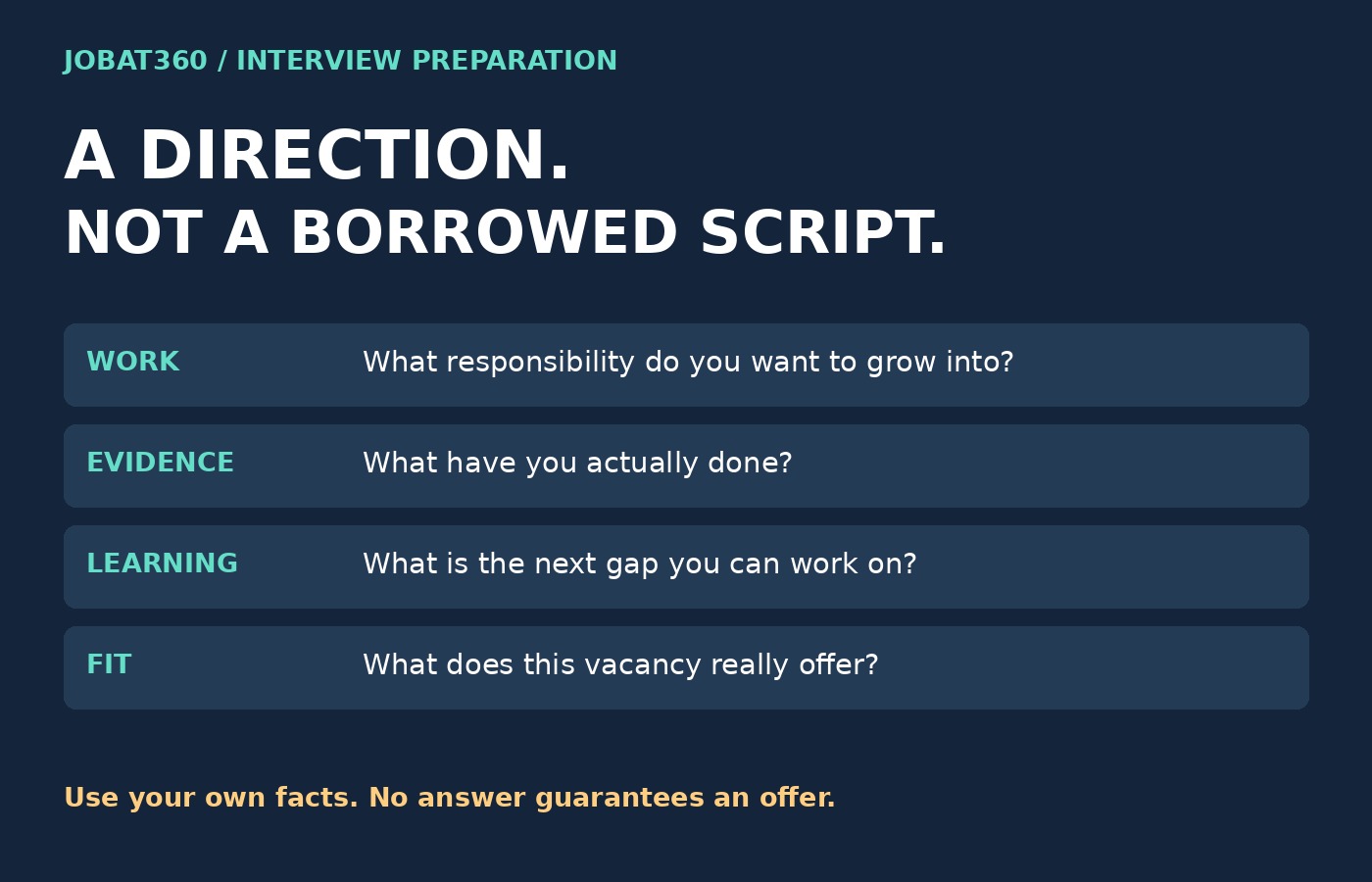
A career aspiration is a direction, not a promise to reach a particular title by a particular birthday. In an interview, the useful task is to explain the work you want to become better at, why this role is a sensible next step and what you are doing to move in that direction.
A borrowed answer about becoming a director can sound polished while saying little about you. A smaller, truthful ambition supported by an example gives the interviewer something concrete to discuss. This guide offers an original preparation method and fictional examples. It does not claim that a particular answer guarantees an offer.
Separate direction, next step and evidence
These three ideas do different jobs. Direction describes the work or responsibility you want to grow towards. Next step describes something you can learn or practise. Evidence explains why the direction is more than an attractive phrase.
For example, “I want to be a manager” names a destination but leaves the work unclear. “I want to become dependable at planning a shift, resolving routine problems and helping newer colleagues” describes responsibilities. A real example of coordinating a small task can then support that interest, without pretending you have already managed a department.
CareerOneStop recommends goals with specific, measurable, attainable, relevant and time-based steps. For an interview, use that discipline to prepare your thinking. Do not turn every answer into a rigid five-year timetable that depends on an employer awarding promotions.
Build a private four-line note
- Work: What kind of problem or responsibility would I like more of?
- Evidence: What have I actually done that points in that direction?
- Learning: What is the next gap I can work on?
- Fit: Which verified part of this vacancy makes it a plausible next step?
This is an editorial worksheet, not a recognised assessment or hiring formula. Read the job description before filling the final line. If the vacancy describes customer support but your answer focuses only on building advertising campaigns, explain the connection honestly or reconsider whether the position fits.
Keep facts, intentions and questions separate. “I completed a class project” is a past fact. “I want to improve my reporting” is an intention. “Does this role include reporting work?” is a question. Do not convert the question into a claim that the employer offers a particular growth path.
A fictional entry-level example
Suppose a fictional applicant has organised a college event registration sheet and is applying for an operations assistant role that explicitly includes records and coordination. Their answer might be:
“I want to grow into operations work where people can rely on me to keep records accurate and follow up on unfinished tasks. During a college event, I maintained the registration sheet and checked missing details with the team. I would now like to learn how a professional team handles handovers and exceptions. The record-keeping and coordination responsibilities in this vacancy are why I applied.”
The example does not invent a percentage improvement or claim managerial experience. It connects one modest activity to a stated interest and a vacancy requirement. Use only your own equivalent facts. If you did not maintain the sheet, do not adopt that line because it sounds credible.
When you are changing fields
A career changer can explain continuity without claiming that two jobs are identical. Identify a transferable action, acknowledge the new learning and show why the change is deliberate.
For a fictional retail worker exploring a support role, the preparation note might read: “I enjoy explaining options to customers. I have experience listening and clarifying requests, but I need to learn this product and its escalation process. I am interested in the support responsibilities described in the vacancy.” This is a starting point for a truthful answer, not a statement that retail experience automatically meets a technical support requirement.
If the role needs a credential or technical skill you do not have, enthusiasm does not replace it. Read the actual eligibility conditions. Describe training as completed only when it is completed, and a project as professional work only when that description is accurate.
When you do not know your long-term title
You can be uncertain about a title while clear about a next step. Try identifying a responsibility you want to understand better, the evidence behind that interest and the way you would test it. For instance, a fictional graduate might want to build reliable analysis skills before deciding between specialist and management paths.
Do not apologise for having no invented master plan. Equally, avoid an answer so open that it could describe any vacancy. “I am still exploring” becomes more useful when followed by what you have explored, what you learned and why this particular work deserves your attention.
Prepare a follow-up, not a longer script
Oxford’s Careers Service advises preparing points tied to the job requirements rather than learning complete answers by rote. CareerOneStop also recommends stories about relevant skills and honest, direct answers. Keep your main answer conversational, then prepare evidence for likely follow-ups.
- Why this direction? Identify a real task you found worthwhile and explain why.
- What have you done already? Describe your own action, not only the team’s achievement.
- What would you learn first? Name a gap rather than claiming you can do everything immediately.
- What if progression is slower? Explain the work you want to learn without demanding an unverified promotion timetable.
For a past example, the National Careers Service’s STAR approach can help separate situation, task, action and result. It also advises being ready for follow-up questions. STAR is useful for the evidence behind your aspiration; it is not a reason to describe a future hope as an achieved result.
Ask whether the opportunity really fits
An interview is also a chance to learn about the role. After checking the employer’s published information, you might ask how new staff receive feedback, what successful performance looks like or which responsibilities normally grow with experience. These questions can reveal whether the work supports your direction.
A friendly answer about “lots of growth” is not a contractual promotion promise. Confirm material conditions separately before accepting an offer. Do not say that a company is your lifelong destination, that you can relocate anywhere or that you will accept any work pattern unless those statements are genuinely yours.
A short rehearsal and honesty check
Explain your answer aloud without reading it. Ask a trusted practice partner to repeat back the direction they heard and the evidence supporting it. If they remember only general words such as growth, passion or success, replace one with an actual task. If they hear an achievement that you did not claim or cannot support, revise the wording.
Then compare the answer with your application. Dates, responsibilities and training status should agree. Remove other people’s achievements, unsupported numbers and assumptions about the employer. Keep the direction, one real reason and the next learning step. Clear does not mean perfectly rehearsed.
Bottom line: describe the work you want to grow into, connect it to something real and explain why this vacancy is a reasonable next step. You are offering an honest direction for a conversation, not predicting your entire career.
Sources and scope, checked 27 November 2026
- Chegg India: 5 Impactful Tips for Answering “What Are Your Career Aspirations?”, source topic read in full. This guide does not reproduce its sample answers or unverified interview-invitation statistic.
- CareerOneStop: Interview tips, relevant examples, preparation and honest answers.
- CareerOneStop: Set career goals, specific goals and reviewable steps.
- Oxford University Careers Service: Interview technique, preparation points rather than memorised scripts. No jurisdiction-specific legal claims from that page are adopted here.
- National Careers Service: Interview advice, preparation, experience and questions for the employer.
- National Careers Service: The STAR method, structuring evidence and handling follow-ups. These overseas public career resources provide general preparation guidance, not Indian recruitment rules.
Jobat360 is an independent information publisher, not a placement agency. The worksheet and fictional examples are learning suggestions, not a hiring assessment. No interview, offer, promotion or earnings outcome is guaranteed.
Disclosure: For information and education only, not investment advice. We are not a SEBI-registered analyst. Double-check original sources before financial decisions. We hold zero shares in companies mentioned in this article. We do not take or promote positions on misleading price information for personal gain, or use this platform to mislead traders or investors. Our purpose is financial literacy and access to information, without a personal or monetary motive behind the information shared.
FOLLOW WOLF OF INDIA, FREE EVERYWHERE
WEBSITES
Wolf of Dalal Street: https://wolfofdalalstreet.com
Stockmarket360: https://stockmarket360.in
BizTechIndia: https://biztechindia.com
Jobat360: https://jobat360.com
Trending on Net: https://trendingonnet.com
Blog + daily digest: https://wolfofdalalstreetofficial.blogspot.com and https://wolfofindia.blogspot.com
APP
Free news app: https://wolfnews.surge.sh (turn on notifications)
YOUTUBE
Wolf of Dalal Street: https://www.youtube.com/@WOLFOFINDIA360
CHANNELS (free updates by message, our newsletter)
WhatsApp channel: https://whatsapp.com/channel/0029VaswZ107YSdBnLu1FY3g
Telegram (Wolf of India): https://t.me/WOLFOFINDIA
Telegram (Wolf of Dalal Street): https://t.me/wolfofdalalstreetofficial
Telegram (Stockmarket360): https://t.me/stockmarket360official
Telegram (BizTechIndia): https://t.me/biztechindia
Telegram (Trending Online): https://t.me/Trendingonlineofficial
WhatsApp Business (join, message preferred): https://wa.me/919619991645
PROFILES
LinkedIn: https://www.linkedin.com/company/wolfofdalalstreet/
Instagram: https://www.instagram.com/wolfofindiaofficial
Facebook: https://facebook.com/wolfofdalalstreetofficial
X: https://x.com/Wolf_India360
Reddit community: https://www.reddit.com/r/WOLFOFDALALSTREETJOIN/
Quora Space: https://wolfofdalalstreet.quora.com
Diigo: https://www.diigo.com/user/wolfdalalstreet
RSS FEEDS
https://wolfofdalalstreet.com/feed/ | https://stockmarket360.in/feed/ | https://biztechindia.com/feed/ | https://jobat360.com/feed/ | https://trendingonnet.com/feed/ | https://wolfofdalalstreetofficial.blogspot.com/feeds/posts/default
Market and business education only. Not investment advice. No tips, no targets.