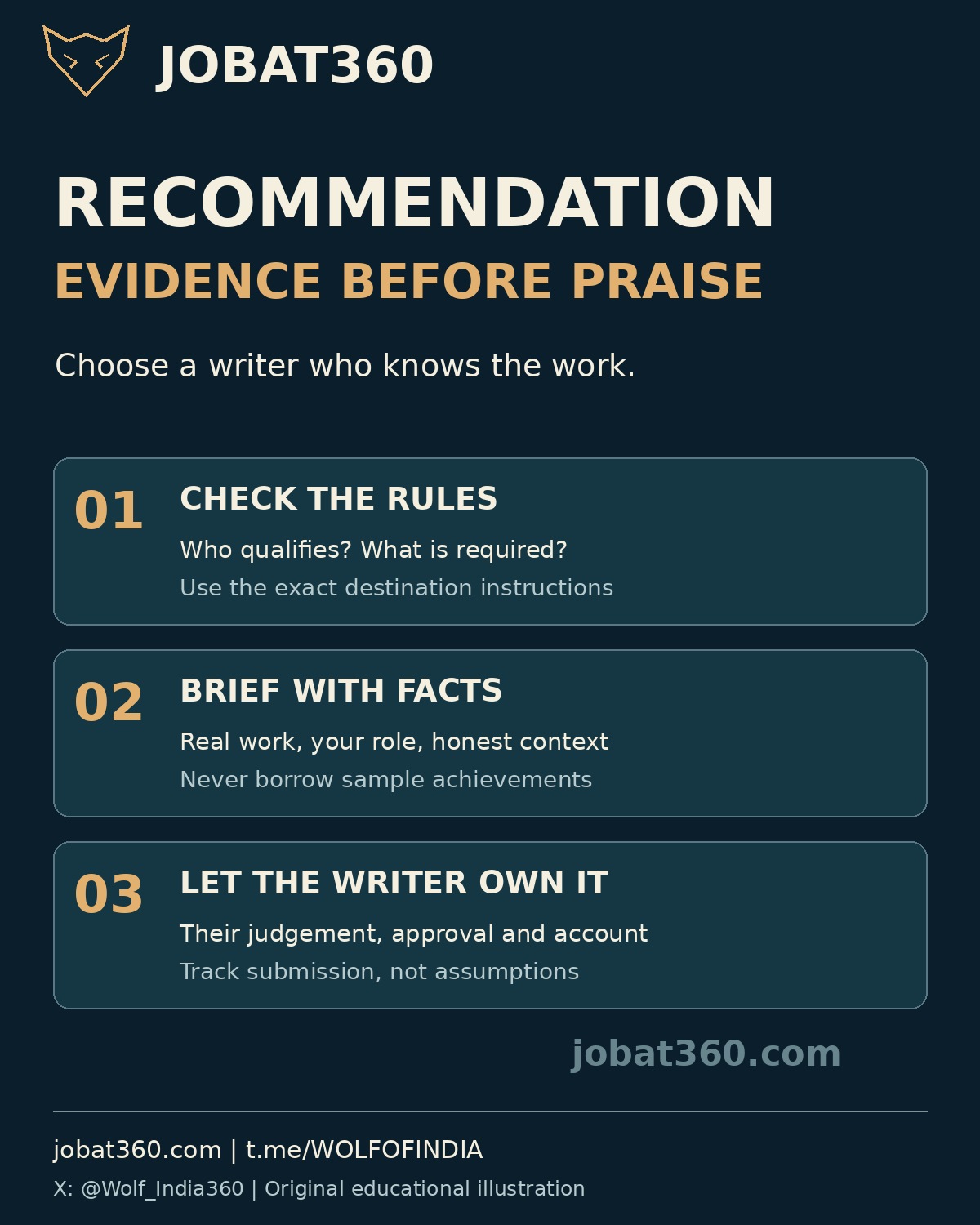
A recommendation letter is most useful when the writer can explain what they actually observed. A famous name, a flattering template or a long list of adjectives cannot replace that evidence.
For students preparing requests, the task is to help a suitable recommender recall relevant work without scripting an endorsement they cannot honestly give. For teachers and supervisors, it is to distinguish personal observation from information the student supplied.
Read the destination’s rules before choosing the writer
Check the current instructions for the exact programme, scholarship or job. Record how many recommendations are required, which relationships qualify, the deadline and timezone, the submission route and any questions the writer must answer. Do not assume that an academic teacher, employer and personal contact are interchangeable.
Yale’s undergraduate admissions guidance provides a specific example. It asks first-year applicants for two recommendations from teachers in core academic subjects and emphasises teachers who know the student well. It says specific discussion is more useful than generic superlatives.
Those are Yale undergraduate instructions, not a universal rule for master’s programmes, Indian colleges or employment references. Use the example to understand why the relationship matters, then verify your own destination’s requirements.
Choose someone who can describe the work
Consider the person who supervised a project, taught a relevant class or directly observed your contribution, if that relationship meets the destination’s rules. Ask whether they have enough context and time to write a useful recommendation. Give them a way to decline without pressure.
A senior person who barely knows you may have less to say than a teacher who watched you work through a difficult problem. Do not offer payment for a false endorsement or imply a relationship that did not exist.
Give a factual briefing, not a ready-made identity
Common App’s recommender guide offers student information sheets, often called brag sheets, to help teachers and counsellors write more personalised letters. Its system also supports organising requests and submitting recommendations. This is an example of preparation within Common App, not a promise that every institution uses that process.
An original briefing sheet can contain:
- The destination: the exact programme or opportunity and a link to its current requirements.
- The relationship: the class, project or reporting period in which the writer knew you.
- Relevant work: two or three genuine examples, with dates or files where appropriate.
- Your contribution: what you personally did, separate from the team’s achievement.
- Growth: a real difficulty, the action taken and what changed.
- Logistics: deadline, timezone, submission instructions and a contact for administrative questions.
Label self-reported achievements as information for the writer to consider. Do not turn a remembered grade, award or ranking into a fact without checking it. Share only material needed for the request, and do not expose other students’ work or private details.
For writers: connect each judgement to an observation
A useful paragraph can establish the setting, describe the student’s action and explain what that action showed. Keep the claim within what you know. If an achievement comes from a student’s CV rather than your own observation, do not present it as something you personally witnessed.
For example, in a fictional classroom project, a teacher might describe a student finding a mismatch between two tables, checking the original records and explaining the correction to the group. That supports a bounded observation about careful checking and communication. It does not establish that the student is the best analyst in the country.
This is an invented illustration of evidence-based writing, not a claim about a real student and not wording to copy as a personal testimonial. Do not borrow sample grades, awards or research experience from an online template.
Let the recommender own the judgement and submission
The writer should decide what they can honestly endorse and approve the final text under their name. A student can provide context and correct factual information without impersonating the writer, signing for them or accessing their account.
If a destination requires a confidential recommendation or a direct invitation to the recommender, follow that route. Do not ask for passwords, forward private sign-in links or upload a letter in someone else’s name. If the process is unclear, ask the receiving institution through its official contact.
If a writer asks you to prepare a draft, clarify the institution’s rules first. Any permitted draft still needs the writer’s independent review, factual corrections and explicit approval. It is not permission to manufacture praise or submit without them.
Track the request without crowding the writer
Keep a simple record of who agreed, the destination, the deadline, the invitation status and whether the receiving system marks the requirement complete. Distinguish an invitation being sent from a recommendation being submitted, and a submission from confirmation that it satisfies the destination’s requirement.
Agree a sensible reminder point with the writer. If the deadline is close and the status is uncertain, ask a short factual question rather than assuming it is done. Do not assume a late-document allowance from one institution applies elsewhere.
If the writer cannot complete the request, check whether the destination permits a replacement and how to make that change. Avoid sending extra recommendations simply to increase the count. Follow the stated requirements.
Review the evidence, not an admissions promise
A letter can add context to an application. It cannot guarantee selection. This guide does not rank the importance of recommendations against grades, tests or experience across institutions.
Before requesting one, check: does this person qualify under the rules, do they know relevant work, have they agreed, and can they meet the actual process? Those answers matter more than copying a persuasive-looking template.
Sources checked 27 November 2026
- Chegg India: Recommendation letters for students, topic source read in full. Sample identities, achievements and admission-impact claims were not reused as facts.
- Yale Undergraduate Admissions: Recommendation Letters, primary example of relationship-specific requirements and preference for concrete observations. Its rules are explicitly limited to that admissions context here.
- Common App: Recommender guide, primary support for recommender workflow and student briefing sheets within its system.
The worksheet and fictional classroom example are original learning aids. Jobat360 is an independent information publisher, not an admissions office or recommendation service. Check the destination’s current instructions before requesting, writing or submitting a letter.
Disclosure: For information and education only, not investment advice. We are not a SEBI-registered analyst. Double-check original sources before financial decisions. We hold zero shares in companies mentioned in this article. We do not take or promote positions on misleading price information for personal gain, or use this platform to mislead traders or investors. Our purpose is financial literacy and access to information, without a personal or monetary motive behind the information shared.
FOLLOW WOLF OF INDIA, FREE EVERYWHERE
WEBSITES
Wolf of Dalal Street: https://wolfofdalalstreet.com
Stockmarket360: https://stockmarket360.in
BizTechIndia: https://biztechindia.com
Jobat360: https://jobat360.com
Trending on Net: https://trendingonnet.com
Blog + daily digest: https://wolfofdalalstreetofficial.blogspot.com and https://wolfofindia.blogspot.com
APP
Free news app: https://wolfnews.surge.sh (turn on notifications)
YOUTUBE
Wolf of Dalal Street: https://www.youtube.com/@WOLFOFINDIA360
CHANNELS (free updates by message, our newsletter)
WhatsApp channel: https://whatsapp.com/channel/0029VaswZ107YSdBnLu1FY3g
Telegram (Wolf of India): https://t.me/WOLFOFINDIA
Telegram (Wolf of Dalal Street): https://t.me/wolfofdalalstreetofficial
Telegram (Stockmarket360): https://t.me/stockmarket360official
Telegram (BizTechIndia): https://t.me/biztechindia
Telegram (Trending Online): https://t.me/Trendingonlineofficial
WhatsApp Business (join, message preferred): https://wa.me/919619991645
PROFILES
LinkedIn: https://www.linkedin.com/company/wolfofdalalstreet/
Instagram: https://www.instagram.com/wolfofindiaofficial
Facebook: https://facebook.com/wolfofdalalstreetofficial
X: https://x.com/Wolf_India360
Reddit community: https://www.reddit.com/r/WOLFOFDALALSTREETJOIN/
Quora Space: https://wolfofdalalstreet.quora.com
Diigo: https://www.diigo.com/user/wolfdalalstreet
RSS FEEDS
https://wolfofdalalstreet.com/feed/ | https://stockmarket360.in/feed/ | https://biztechindia.com/feed/ | https://jobat360.com/feed/ | https://trendingonnet.com/feed/ | https://wolfofdalalstreetofficial.blogspot.com/feeds/posts/default
Market and business education only. Not investment advice. No tips, no targets.